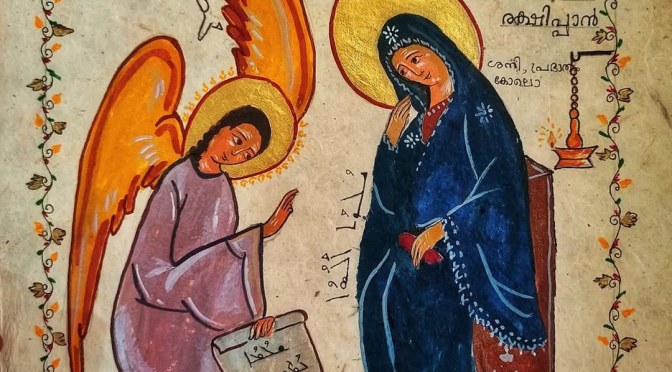
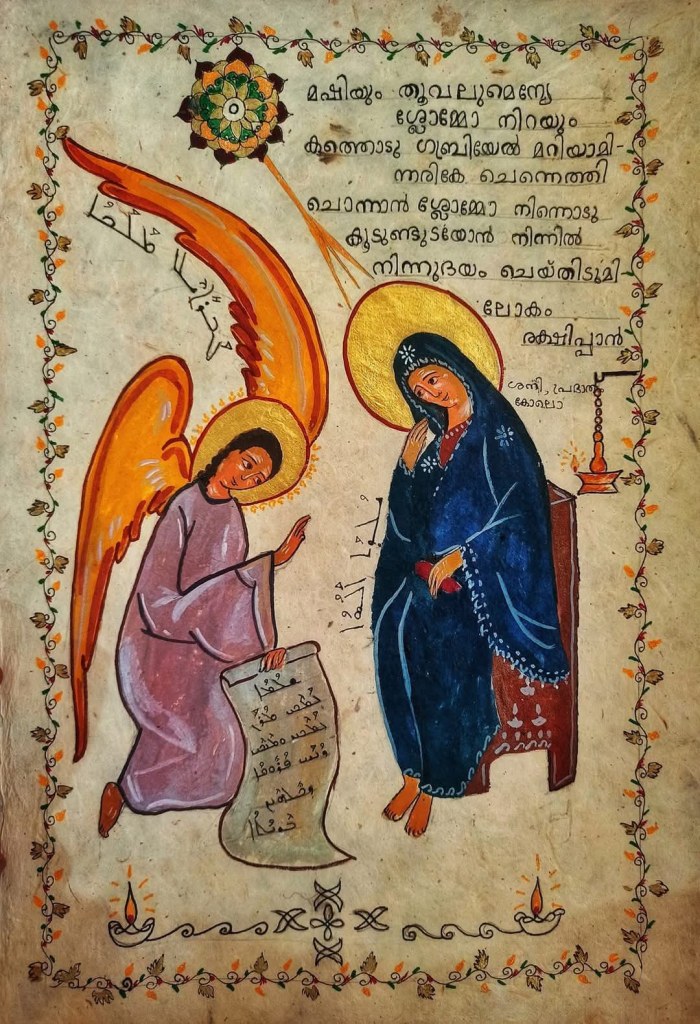
ചൊന്നാൻശ്ലോമ്മോ നിന്നോടുകൂടുണ്ടുടയോൻനിന്നിൽ നിന്നുദയം ചെയ്തിടുമീ ലോകം രക്ഷിപ്പാൻ
The Annunciation reveals a moment where eternity touches time—where divine humility meets human openness.Gabriel’s greeting becomes the doorway through which salvation enters the world. In Mary’s quiet “yes,” creation finds hope, and the long-awaited Redeemer steps into history.
This illuminated icon seeks to reflect that sacred wonder.
This icon is done on a Hand-made Batik sheet, it’s an illuminated-text Icon by the unworthy hands of
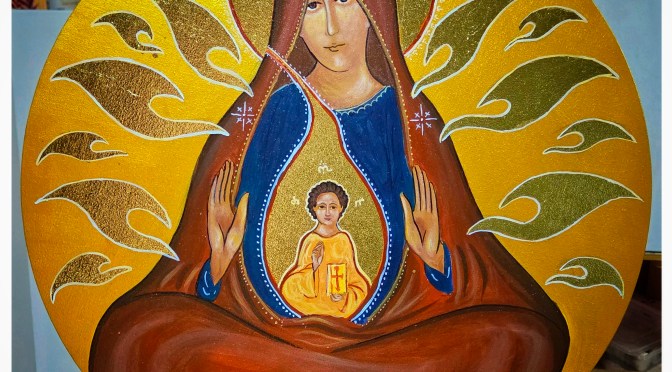
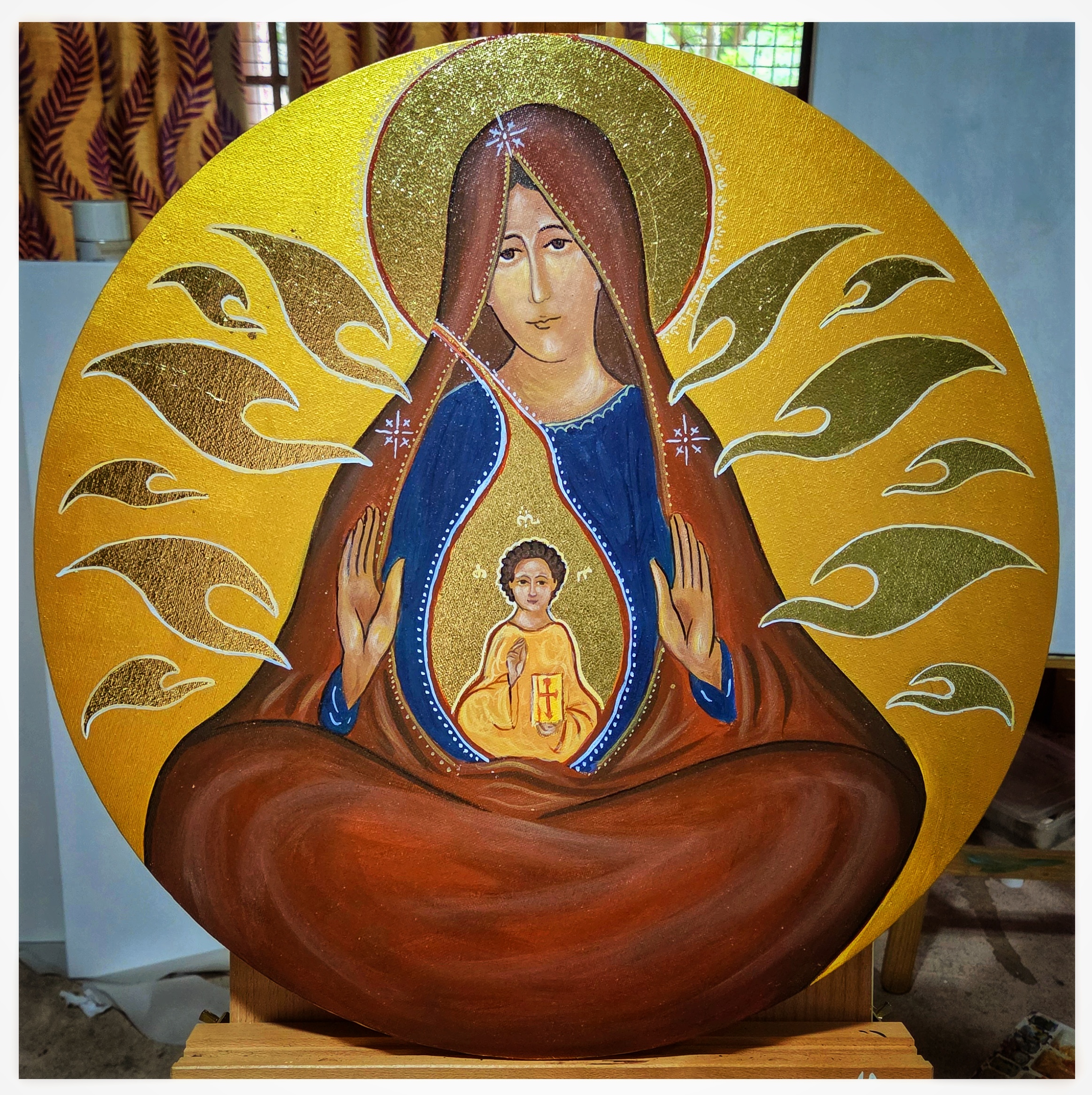
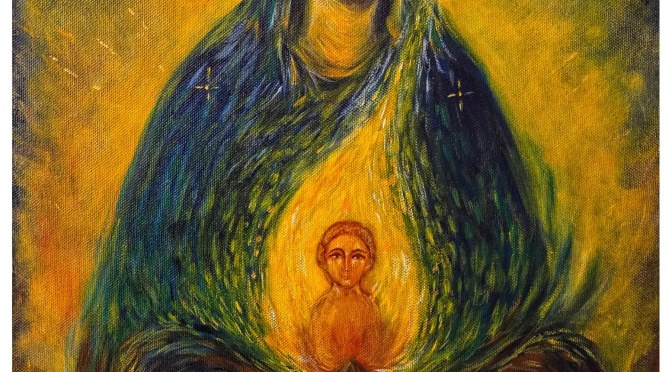
This icon titled “Mother of the Light” (Emme d-Nuhro or Emme d’nuhro) presents Mother Mary as a serene, luminous figure. From within her radiates the eternal flame of Christ, depicted here as a “diya” or “deepak”, the traditional oil lamp of Indian culture.
The flame within her is not merely a source of illumination but becomes the source of her own radiance. It reflects the profound theological truth that the holiness of the saints (symbolized by the halo) is not separate from Christ but born of Him. Mother Mary’s light is Christ’s light, dwelling within her, transforming and glorifying her.
According to St. Ephrem, the more light that enters the eye, the more the eye is enabled to see (Which is basis of optics). He applies this to the inner eye, for which faith takes the place of light: the greater the faith, the more the interior eye perceives the spiritual world. In the case of Mary, it is Christ Himself—the Light—who enters her:St Ephrem writes,
As though on an eye,the Light settled in Mary,it polished her mind,made bright her thought,and pure her understanding,causing her virginity to shine. (Hymns on the Church)
This theological vision resonates with the imagery of this Icon. The deepak’s glow is not external but proceeds from the divine Light who dwelt within her. As St. Jacob of Serugh beautifully proclaims:
“O Mary, you are the house of beauties and the storehouse of treasures, the Mother of the Sun, who generates unlimited light.”
In this image, the light of the deepak rises and extends outward, forming a radiant glow that encircles her—a visual testament to the intimate mystery of the Incarnation, where the uncreated Light takes flesh within her, making her truly the Mother of Light.
Fr. Rijo Geevarghese, Diocese of Ahmedabad Sopana Orthodox Academy
In Orthodox tradition, Mother Mary and the virgin birth of Christ are expressed through rich typologies in Christian tradition. I earlier tried to cover some of them in my Channel (link below).
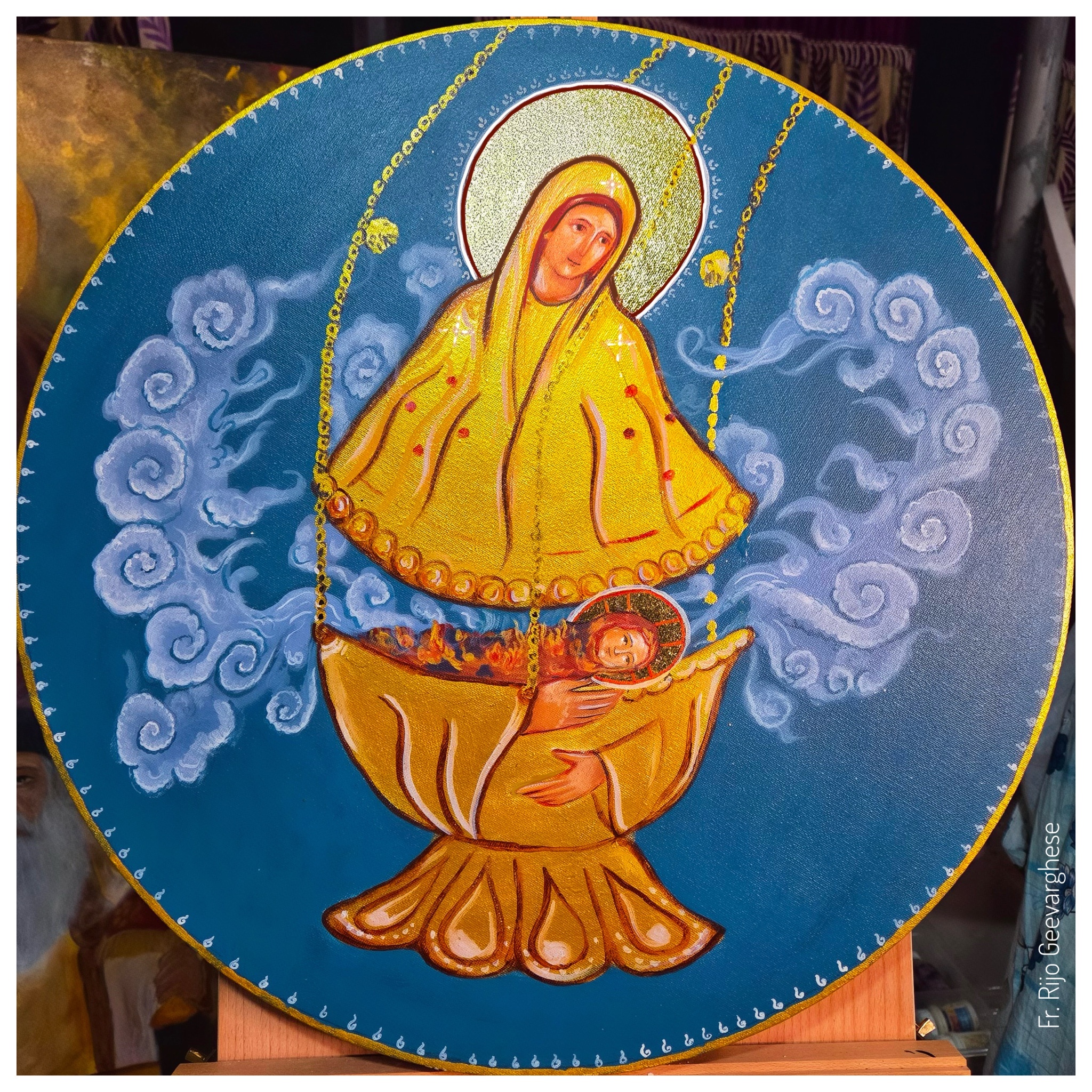
Each typology reveals an aspect of the mystery of the Incarnation.One profound typology is that of Mother Mary as the Golden Censer. Sharing an Icon of Mother as the Golden censer. Her womb is called the holy censer because it bore the living burning coal —Christ Himself.
Though its a familar typology in Orthodox church, I found this imagery recently in the readings of Feast of Dormition.
Here are three of them,Malayalam: “നിർമ്മലകന്യകയുടെ പരിശുദ്ധ ഗർഭപാത്രമാകുന്ന പാവനധൂപകലശത്തിൽ വയ്ക്കപ്പെടുകയും”.
English: Christ was placed in the holy censer, which is the pure womb of the VirginEvening Ethro , Dormition of Mother Mary
Another one says,
“സംയോജിപ്പിന്റെ ധൂപമായിത്തീർണ സ്വർണചെപ്പേ”.“O golden censer, who became the incense of union…” (Night Sedra, Dormition of Mother Mary)
Another connect her with the High Priesthood of Christ.
English:“O pure censer of the heavenly High Priest! Peace.” (Sedra reading, Dormition of Mother Mary.)
This icon of Theotokos as the Golden Censer proclaims Mary not only as the vessel but also Christ as the fragrance of life (msheeho, reeho hayutso)
As St Ephrem says, When eaten as the Bread of Life, Christ pervades whole of the believer’s being. When inhaled as the Fragrance of Life, Christ again penetrates throughout the believer.(Thoughts from Hymns on Nativity and Virginity) ജീവൻ്റെ സുഗന്ധമായി ശ്വസിക്കുമ്പോൾക്രിസ്തു വീണ്ടും വിശ്വാസിയിലുടനീളം വ്യാപിക്കുന്നു.
So too, in contemplating Mary as the Golden Censer, we see her not only as the vessel of divine fire but as the one who offers Christ, the life-giving fragrance, to the world.May this image invite us to breathe in Christ, who fills all creation with the fragrance of life.
This liturgical painting titled “Mother of Light” (Emme d-Nuhro or Emme d’nuhro in Syriac) presents Mother Mary as a serene, luminous figure. From within her radiates the eternal flame of Christ, depicted here as a diya or deepak, the traditional oil lamp of Indian culture.
The flame within her is not merely a source of illumination but also becomes the source of her own radiance. It reflects the profound theological truth that the holiness of the saints (symbolized by the halo) is not separate from Christ but born of Him.
Mother Mary’s light is Christ’s light, dwelling within her, transforming and glorifying her. As St Jacob of Serugh writes:O Mary, you are the house of beauties and the storehouse of treasures,the Mother of the Sun, who generates unlimited light.
In this image, the light of the deepak rises and extends outward, forming a glow that encircles her, a visual testament to the intimate mystery of the Incarnation, where the uncreated Light takes flesh within her, and in doing so, makes her the Mother of Light.
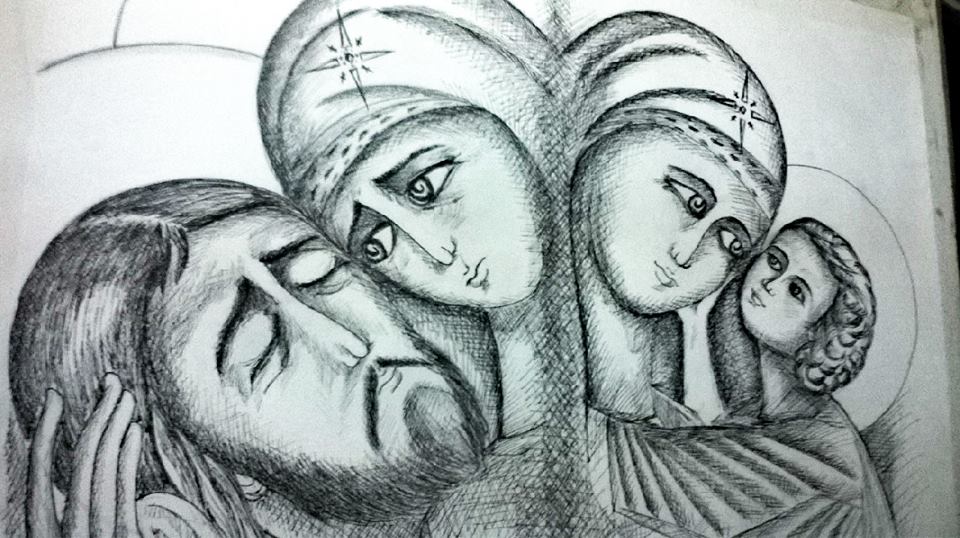
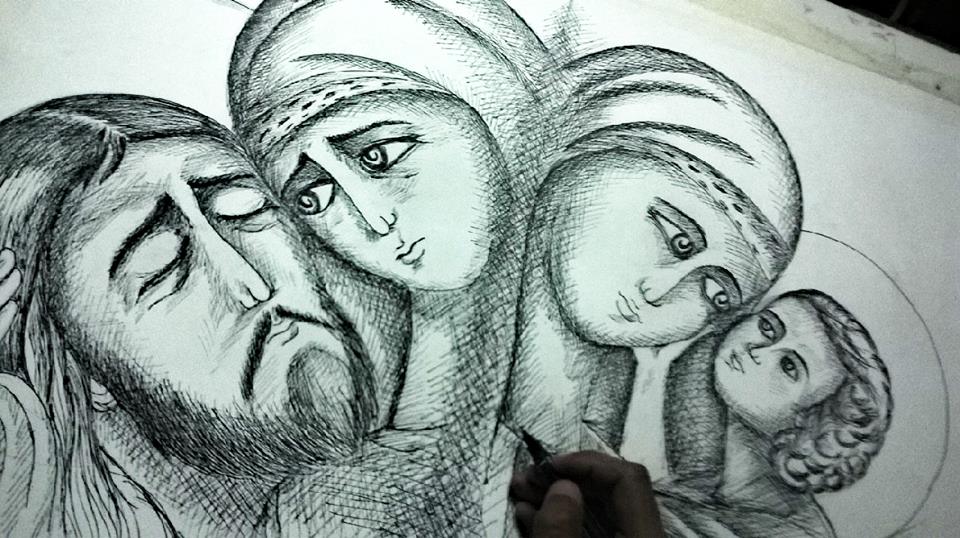
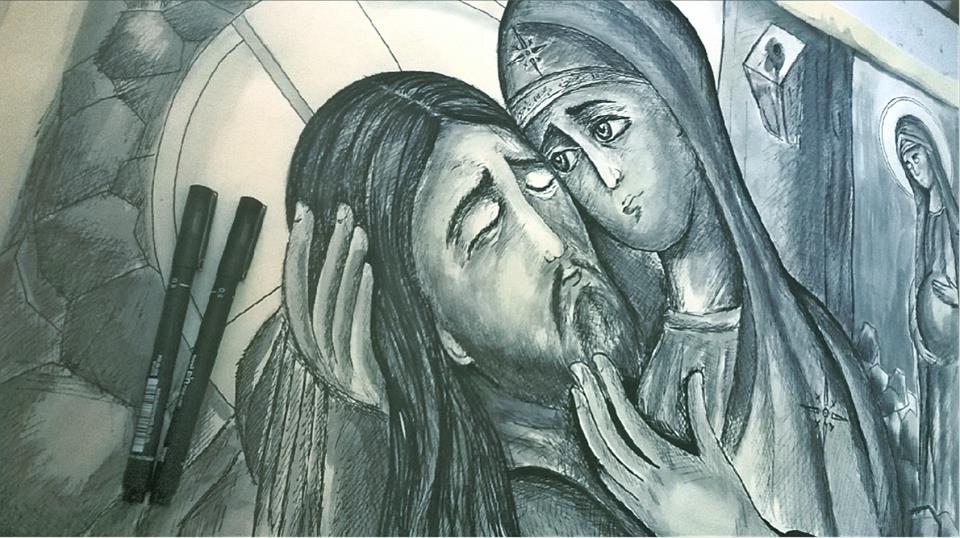
+++ “A mother Receiving her Child”
Slowly, carefully, hand over hand His body lowered down from the Cross. Mary reaches toward him, Not knowing whether to assist Or wait to receive it. Casting around for a place,
Finally, she sits on Golgotha’s cold stone the way she sat in that cold Bethlehem night. But this time its Golgotha’s cold stone. Where they lay him on her lap
A mother Receiving her Child from Cross…..
COMMUNION OF THE MOTHER OF GOD (Manna Makalkayi)
The Old Testament is filled with the stories of people and events that builds up the history of God’s chosen people, Israel. But we may often wonder, “What do all these stories mean?” We are also told that in Christ, the whole Bible holds together. How can we see our Lord Jesus Christ in the people, events, and prophecies of the Old Testament?
We can find many symbols representing Holy #Theotokos (Mother of God) in Old testament. These symbols are also mentioned in Madyastha Prarthanagal, Theotokias ( Coptic Midnight Praise), as well as other hymns chanted during the Divine Liturgy. Lets understand these symbols. #Orthopost
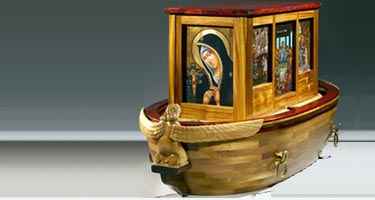
Mary , the noah’s ark
The Ark of Noah (Genesis 6-9) In his first epistle, Saint Peter writes that by Noah,
“…eight souls, were saved through water. There is also an anti type which now saves us – baptism” (1 Peter 3:20-21).
Saint Peter makes the connection between the event of Noah’s Ark, and the salvation in Christ through baptism. Noah, then, is a type of Christ, while the ark itself symbolizes Saint Mary. Just as the ark received Noah and became a means of saving the world, Saint Mary received God the Word and gave Him the human body by which He died for our salvation.
Icon with Jacobs ladder , above a depiction of Theotokos
The Ladder of Jacob (Genesis 28:10-17)
When Jacob fled from his brother Esau, he saw a vision of a ladder that was set upon the earth with its top reaching to heaven. The Lord stood above this ladder and the angels of God ascended and descended on it. The Lord stood above this ladder expressing His intent to descend on it. It is through His incarnation that the Lord descended from heaven and manifested Himself to us. The ascending and descending of angels point to their ministering to Saint Mary. Archangel Gabriel announced the birth of our Savior to Saint Mary (Luke 1:26-39). An angel also appeared to Saint Joseph telling him not to be afraid, but to keep Saint Mary at his house (Matthew 1:18-25). The angels also led the Holy Family as they fled from Herod (Matthew 2). Jacob’s ladder, therefore, is a type of Saint Mary, who tied heaven and earth together through the body of the Lord which was taken from her. She also intercedes on our behalf, carrying our prayers to our Lord in heaven.
Mary. the Burning bush(coptic Icon)
The Burning Bush (Exodus 3)
While tending to the flock of his father in law, Moses saw a burning bush. Although it was burning with fire, the bush was not consumed. The burning bush represents Saint Mary who carried the fire of the Lord’s divinity without her wo
A tabernacle
mb being consumed. After she gave birth to the Lord, Saint Mary’s virginity also remained sealed; that is, it was not consumed.
The Tabernacle
In the Book of Exodus, we read of the building of the Tabernacle. God spoke to Moses saying, “I will consecrate the tabernacle of meeting and the altar… I will dwell among the children of Israel and be their God” (Exodus 29:44-45). The Tabernacle is likened to Saint Mary, for the Lord dwelt in her.
A replica of Golden pot of Manna
The Pot of Manna (Exodus 16)
After their escape from Egypt, the children of Israel ate manna in the wilderness for forty years. God spoke to Moses saying, “Behold I will rain bread from heaven for you…Take a pot and put an omer of manna in it, and lay it up before the LORD, to be kept for your generations” (Exodus 16:4,33). This pot was then kept in the Ark of the Covenant along with the tablets on which the Ten Commandments were written, as well as the rod of Aaron. Our Lord Jesus Christ also spoke to the Jews saying, “I am the bread of life. Your fathers ate the manna in the wilderness, and are dead. This is the bread which comes down from heaven, that one may eat of it and not die. I am the living bread which came down from heaven. If anyone eats of this bread, he will live forever; and the bread that I shall give is My flesh, which I shall give for the life of the world” (John 6:48-51). If the manna is a type of Christ, Who is the bread of life coming down from even, then the pot made of pure gold, which carried the manna, is a type of the pure Saint Mary, who carried the Lord in her womb.
“At your hand stands the queen in gold from Ophir” (Psalm 45:9).
This is why in her Icon, she is portrayed at the right hand of Christ our Lord and King.
Aaron’s blossoming rod
The Rod of Aaron (Numbers 17:1-8)
In Numbers 16, we read of Korah who rebelled against God, Moses, and Aaron and claimed for themselves the priesthood. The Lord wished to reveal to the people of Israel to which tribe the priesthood rightly belonged. Each tribe presented a rod and placed it in the tabernacle of meeting. Aaron’s name was placed on the rod of the tribe of Levi. The rod of Aaron sprouted and put forth buds, producing blossoms and yielding ripe almonds, as a sign that God had chosen the tribe of Levi. The barren rod which blossomed without planting or watering is a symbol of Saint Mary, who, being a virgin, brought forth the Fruit of Life. It is also a symbol of the human soul; although weak in itself, through God’s grace can bring forth the fruit of the Spirit.
The closed gate of temple, Jerusalem
The Gate of Ezekiel
Ezekiel the prophet said, “Then He brought me back to the outer gate of the sanctuary which faces toward the east, but it was shut. And the Lord said to me, ‘This gate shall be shut; it shall not be opened, and no man shall enter by it, because the Lord God of Israel has entered by it; therefore it shall be shut” (Ezekiel 44:1-2). This gate, which Ezekiel saw, is a type of Saint Mary. She is the gate through which the Lord entered. After she gave birth to Him, the gate remained shut; that is, she remained a virgin and no other man entered into her womb.
Censer
The Censer
The golden censer, used in Church worship, is also a type of Saint Mary. The live coal in the censer, according to Saint Cyril the Great, points to the unity of the divinity and humanity of Christ. Just as the censer carries the fiery coal, so also the Lord dwelt in the womb of the Virgin. The aroma of incense coming from the censer is likened to the sweet-smelling sacrifice of our Savior. As the church chants in the Hymn of the Censer, “The golden censer is the Virgin. Her aroma is our Savior.”
You prepared the world to receive You, now also purify our hearts to receive You always.We ask this through the intercessions of Your holy and pure mother, Saint Mary.
Amen.
*Do mail /comment, if you have any other symbols for Mother Mary.





 Graphē