
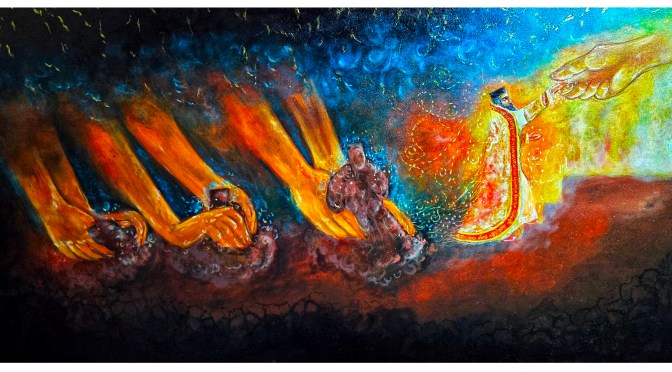
Priest, Raised from Dust of Earth
A Visual Contemplation on Priesthood from a Liturgical Reading
The priest stands at the altar clothed in light, yet at his very core he remains the fragile dust of the earth. This paradox – dust and glory, earth and heaven – lies at the heart of the Orthodox vision of priesthood. The painting “Priest, Raised from Dust of Earth” seeks to visually contemplate this mystery through the lens of liturgical texts: the Sedro reading from the Holy Qurbana Taksa, the Funeral Service of Priests, and a Qolo from the Friday Evening (Ramsho) prayers.
1. The Dust of Creation and the Hands of God
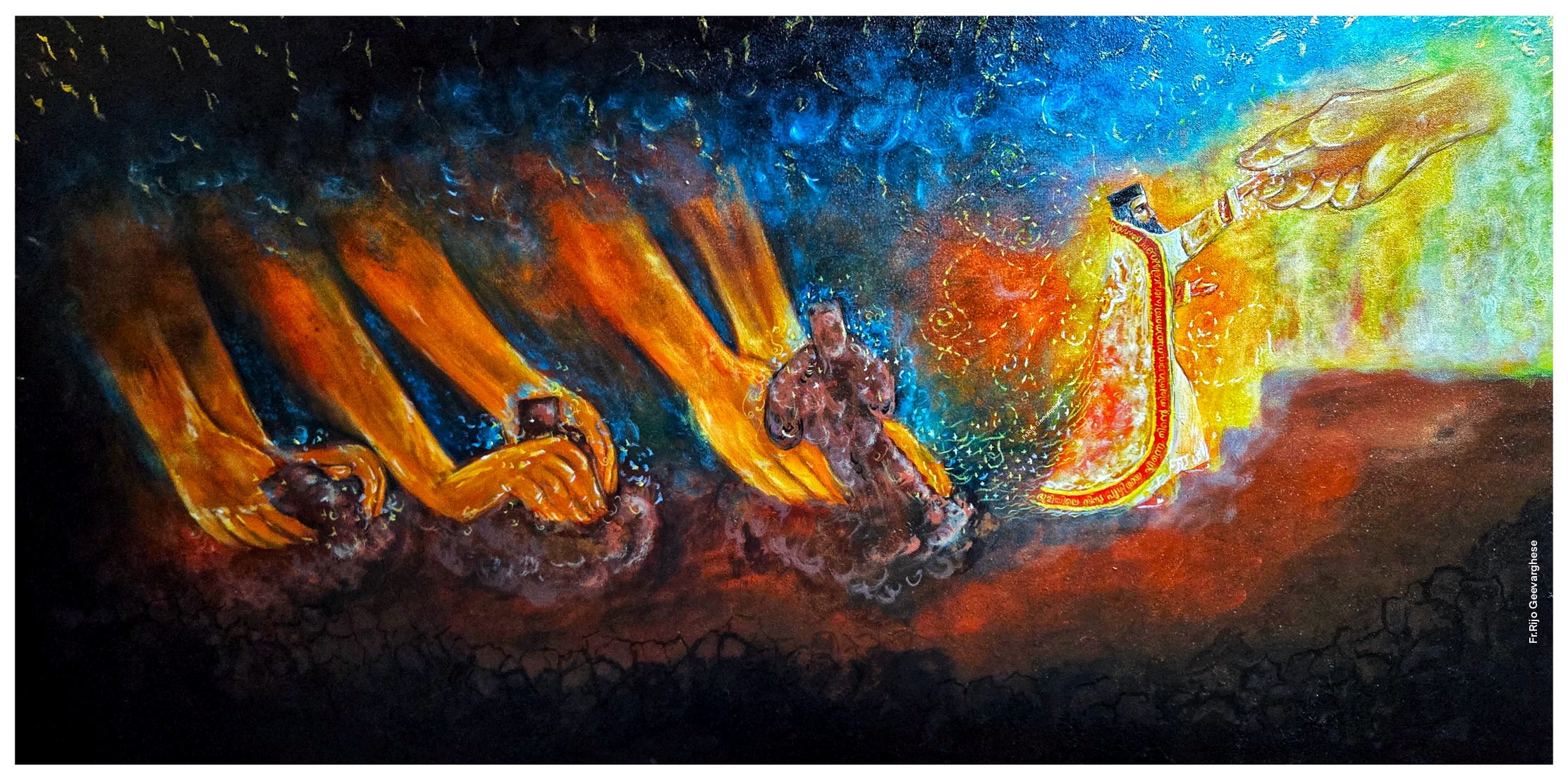
On the left side of the painting, we see the divine hands gathering the dust of the earth, forming the first human being. This recalls the hymn from the Funeral Service of Priests:“From the four directions the Lord took dust in His hand and created Adam in His own image.”
This tradition resonates both with the Syriac liturgy and with the Midrash Rabbah on Genesis, which tells us that God gathered dust from the four corners of the earth so that every place might claim humanity as its own. The image proclaims that the priest, like Adam, is drawn from creation itself, embodying the fragility and the universality of the human condition. He is nothing but dust – yet dust touched and shaped by the very hands of God.
2. Priesthood as New Creation
The right side of the painting shifts the focus to the priest clothed in vestments, his hands stretched toward the heavenly hand that pours forth divine grace. This visual echoes baptism, where water is drawn from the four corners of creation to sanctify and renew. As St. Paul writes, “If anyone is in Christ, he is a new creation” (2 Corinthians 5:17).
Here, the act of God shaping Adam from dust parallels the act of God renewing humanity through sacramental grace. The priest himself becomes a participant in this mystery – not merely as an officiant, but as one who has himself been reshaped and reborn in Christ.
The liturgical Sedro(eighth) captures this paradox:“You have raised me, a despicable dust of the earth, to enter the dwelling of Your divine mysteries, and lifted me to the Holy of Holies of Your Majesty.”
3. Priesthood Between Dust and Glory
The Qolo from Friday Evening (Ramsho) deepens this tension:“You created me and placed Your hands upon me…” (സൃഷ്ടിച്ചെന്മേൽ നിൻ കൈവെച്ചു).
The imagery affirms that priesthood is not self-derived but wholly a gift. It is God who fashions, raises, and sanctifies the human being from dust, clothing him with the radiant vestments of service. Even in death, as proclaimed in the Funeral Service of Priests, the priest is remembered as one who bore the imprint of both creation’s frailty and heaven’s glory.We are dust – yet in Christ, dust is raised into glory.
Fr Rijo Geevarghese
Diocese of Ahmedabad
Sopana Orthodox Academy
 Graphē