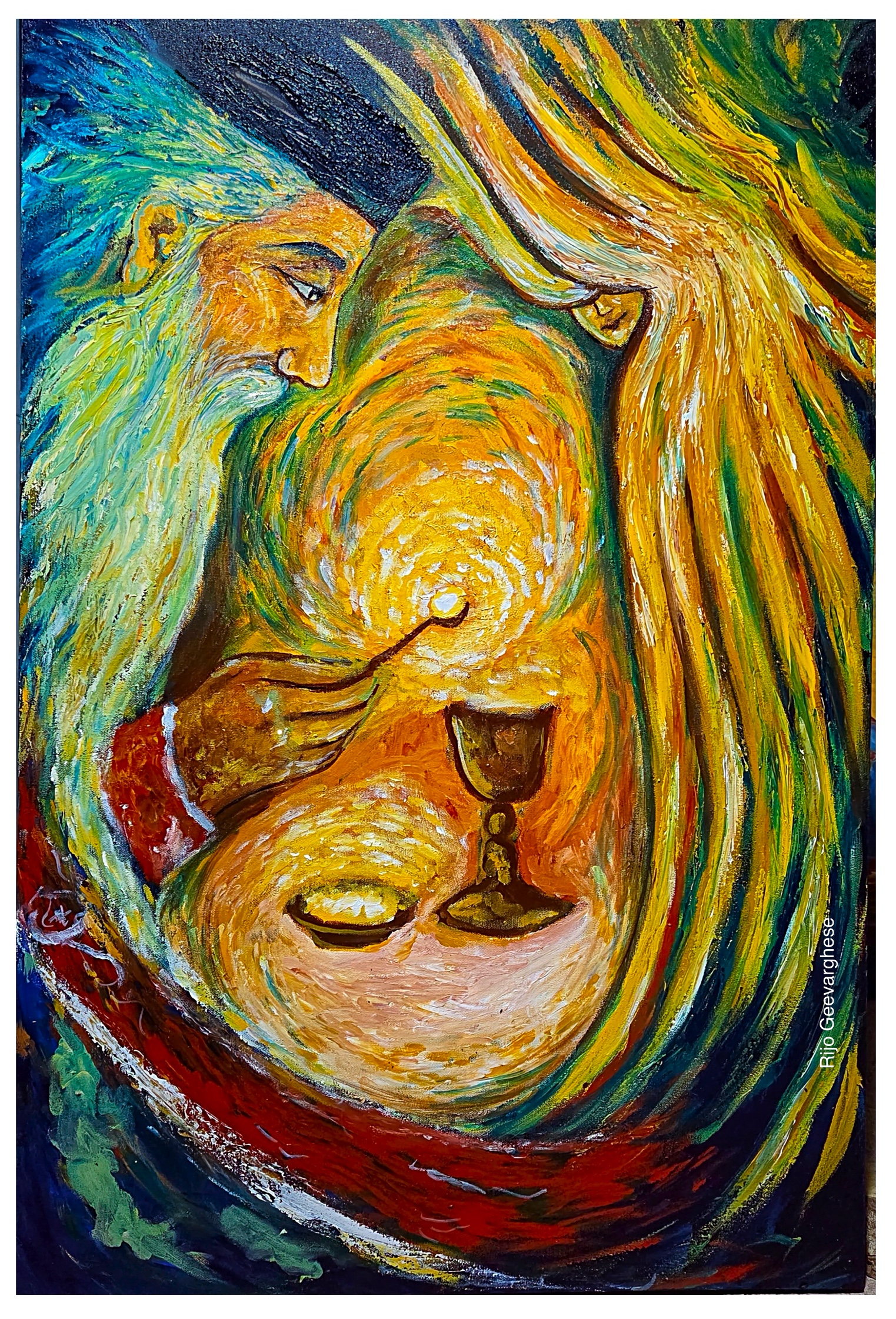
As the Holy Church prepares for the Holy Mooron Consecration (മൂറോൻ കൂദാശ | Holy Chrism), I share this liturgical painting.
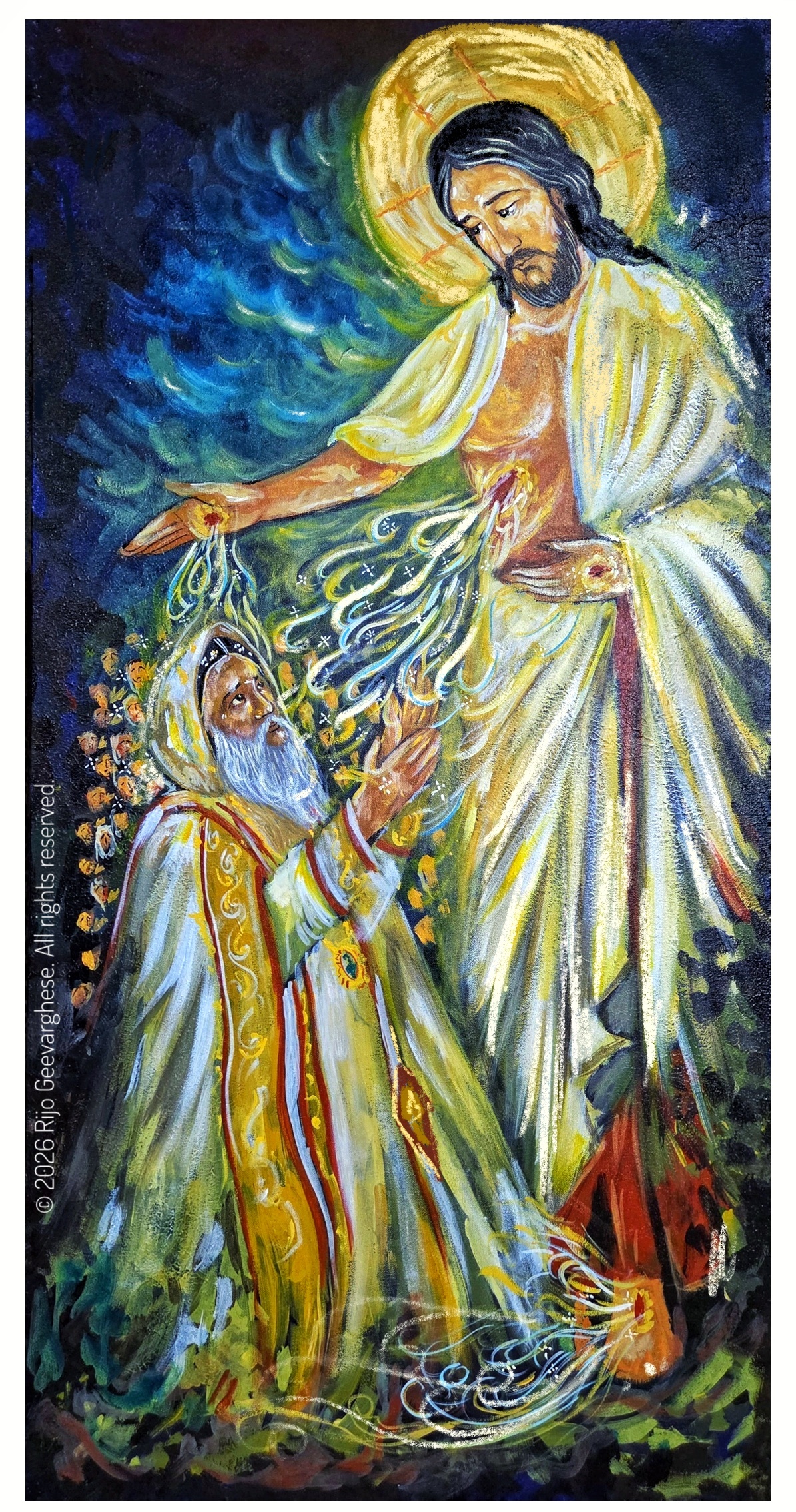
This work is inspired by a hymn from the Evening Prayer (Kymtho):
“The scent of Chrism, O Lord, rises from Your wounds”(നിൻ മുറിവുകളീന്നേറ്റേൻ മൂറോൻ…)
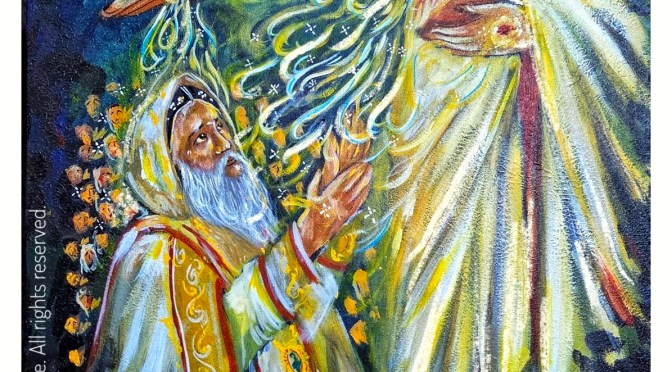
In this painting, Christ stands as the eternal source of grace. From His holy wounds flows not blood alone, but the fragrant mystery of the Mooron—the life of the Spirit poured out for the Church.
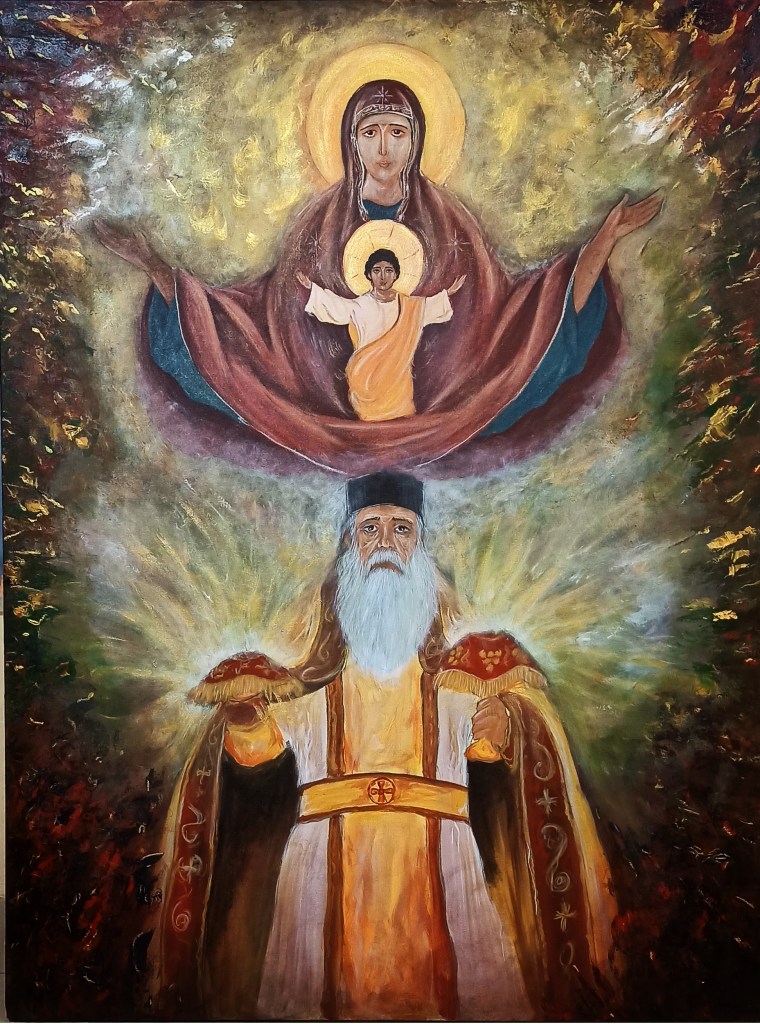
As St. John Chrysostom teaches, “the side of Christ is the beginning of all the Holy Mysteries of the Church” (Homilies on John 85). From that pierced side flows the life of the Church.In the painting below, the Catholicos, the shepherd of the Church, stands with open hands—not to take, but to receive.
What is given from Christ becomes the life of the Church. From the wounds of Christ – to the hands of the shepherd, and from the shepherd to the faithful—the mystery continues.
Hybrid Mode: Online lectures with a mandatory offline residential practical session.
Hybrid Mode: Online lectures with a mandatory offline residential practical session.
This six-month Certificate Program in Sacred Art andSpirituality forms students to understand, practice, and live the tradition of Orthodox iconography. It is an intensive course covering history, symbolism,philosophical and theological approaches, liturgical significance, andpractical studio training. The program seeks to bring together Orthodox faith,culture, and creativity in the service of the Church.
A genuine desire to learn Orthodox Iconography and deepen spiritual life.
Ability to attend both online lectures and the mandatory residential practicalsession at Sopana Orthodox Academy, Mar Baselios Dayara, Njaliakuzhy, Kottayam.
Language: Basic proficiency in English or Malayalam (the medium of instruction may includeboth).
Subjects
1. History of Art & Art in the Church
2. Foundation of Sacred Art & Theology
3. Iconography & Symbolism
4. Art & Spirituality
5. Sacred Art in the Indian Context
6. Basic Skill Development
7. Practical – Writing an Icon
Credits·
Theory (1, 2, 3, 4, 5, 6): 12 credits.·
Practical Icon Writing (7): 4 credits.·
Total: 16 credits.
Proposed Course Calendar
January – May
Mode: Online
Schedule: Tuesdays, 8:00 pm – 9:00 pm (twice a month)
There might be guest lectures.
Focus: Theory modules—History, Symbolism, Theology, Spirituality.
May – June (7-day Residential Block)
• Mode: Offline at Sopana Orthodox Academy, Mar Baselios Dayara, Njaliakuzhy, Kottayam.
• Focus: Practical Icon Writing Workshop and spiritual immersion.
Late June
• Mode: Online
• Focus: Project submission, exhibition presentation, and final evaluation.
There will be a study tour to selected ancient Christian heritage sites as part of the program. Additional charges may apply depending on the location and logistics.
Important Points for Students·
This is a six-month intensive formation program in sacred art andspirituality.
The workshop will be in the last week of May or the first week of June.Dates will be informed by February.
Regular attendance for online weekend sessions is required.
No prior art experience is needed, but dedication and consistentpractice are expected.
The residential practical session in May/June is compulsory forcertification.
All assignments should be submitted on time.
The goal is not only artistic skill but also inner transformation and growthin faith.
For more details, contact Fr. Rijo Geevarghese (Coordinator, Sacred Art Wing, Sopana Orthodox Academy).
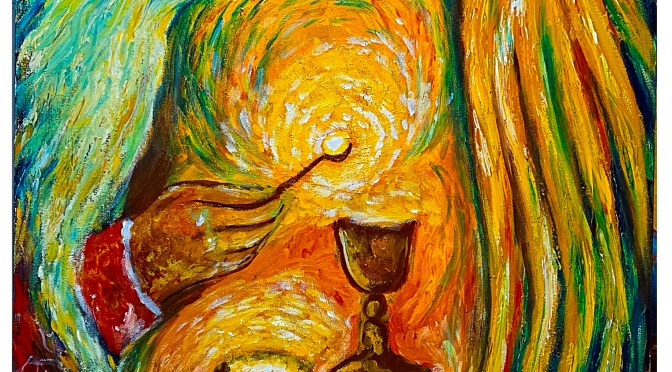
This liturgical painting, titled “A Divine Paradox,” is a visual contemplation drawn from a majestic moments in the Orthodox liturgy visually expreased in the post-communion hymn:
Fiery ones fear to gaze upon the Lord. You have seen Him in Bread and Wine on the Altar. If those clothed in lightning beheld Him, they would burn, Yet shameful dust stands unveiled when they consume Him.
അഗ്നിമയന്മാർ ആരെ നോക്കിൽ വിറച്ചീടുന്നു അവനെ മേശയിൽ അപ്പം വീഞ്ഞായ് നീ കാണുന്നു ആരെ മിന്നലുടുത്തോർ നോക്കുകിലെരിയുന്നൂടനെ അവനെ മണ്മയർ ഭക്ഷിച്ച് മുഖം തെളിയുന്നേറ്റം
The painting reflects the wondrous mystery that while the fiery angels dare not look upon the Lord, we—priests and laity alike—formed from dust, are invited to behold Him and partake of Him. The central image captures that sacred moment during the Holy Eucharist when the celebrant priest, lifting the Holy Mysteries with the Tharvodo (spoon), prays “I am holding You who hold the boundaries of creation.” (അതിർത്തികളെ വഹിച്ചിരിക്കുന്നവനേ! നിന്നെ ഞാൻ എടുക്കുന്നു)
This visual meditation is also inspired by other liturgical hymns and prayers—such as the eighth Sedra of the Holy Qurbana, where the priest confesses: “I, who am despicable dust” (ഭൂമിയിലെ നിന്ദ്യ പൂഴിയായ എന്നെ), yet is granted the grace to stand in the radiant presence of the Shekinah and receive the Divine Mysteries.
Such imagery found throughout the Orthodox liturgy, revealing the paradox of divine mercy, that the unworthy are made worthy to stand before the Holy.
Painted by the unworthy hands of Fr. Rijo Geevarghese Diocese of Ahmedabad
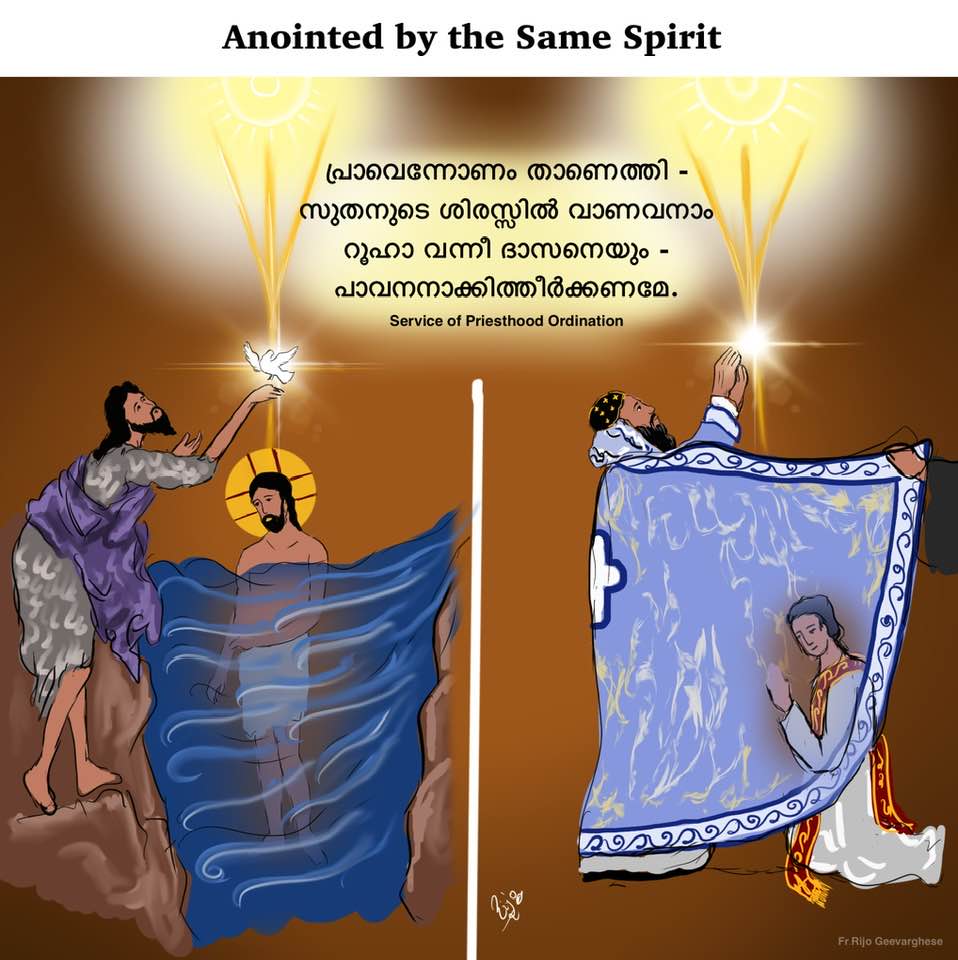
A Visual Contemplation on the Ordination service and the Epiphany
Every time I witness the moment when the Holy Spirit descends upon a candidate during the Service of Priesthood Ordination—as the congregation sings “Parakalitha Roha Vannethi” (“May the Holy Spirit come”) and the celebrant priest waves his hands like the fluttering of a descending dove—my mind is drawn to the icon of the Epiphany: Christ standing in the waters of the Jordan, and John the Baptist extending his hand in the role of the priest.
In that moment through the icon of Epiphany, I see a mirror of every priestly ordination.
This connection is not coincidental, it is deeply embedded in the liturgical and theological tradition of the Orthodox Church.
Here I have attempted to express this contemplative vision through this illustration, inspired by the ordination hymn:
O Spirit, Who like a dove Descended upon the Son, Come and dwell on this servant, Sanctify him by Your grace.
The same Holy Spirit who descended upon Christ in the Jordan now descends upon the servant at the altar. This continuity is not merely poetic or symbolic—it is apostolic. It flows from the hands of John the Baptist through the generations, as sung in the Kukilion for departed clergy:
“Moses and Aaron received The priesthood which was passed down It went to Zachariah Then it was given to John John then gave it to our Lord, and Lord to all his Dsiciples…”
Thus, the priestly lineage flows unbroken, and in every ordination, the heavens open once again. The Spirit descends. The servant is sanctified. And the Church beholds anew:
This is My beloved Son… This is My chosen servant…
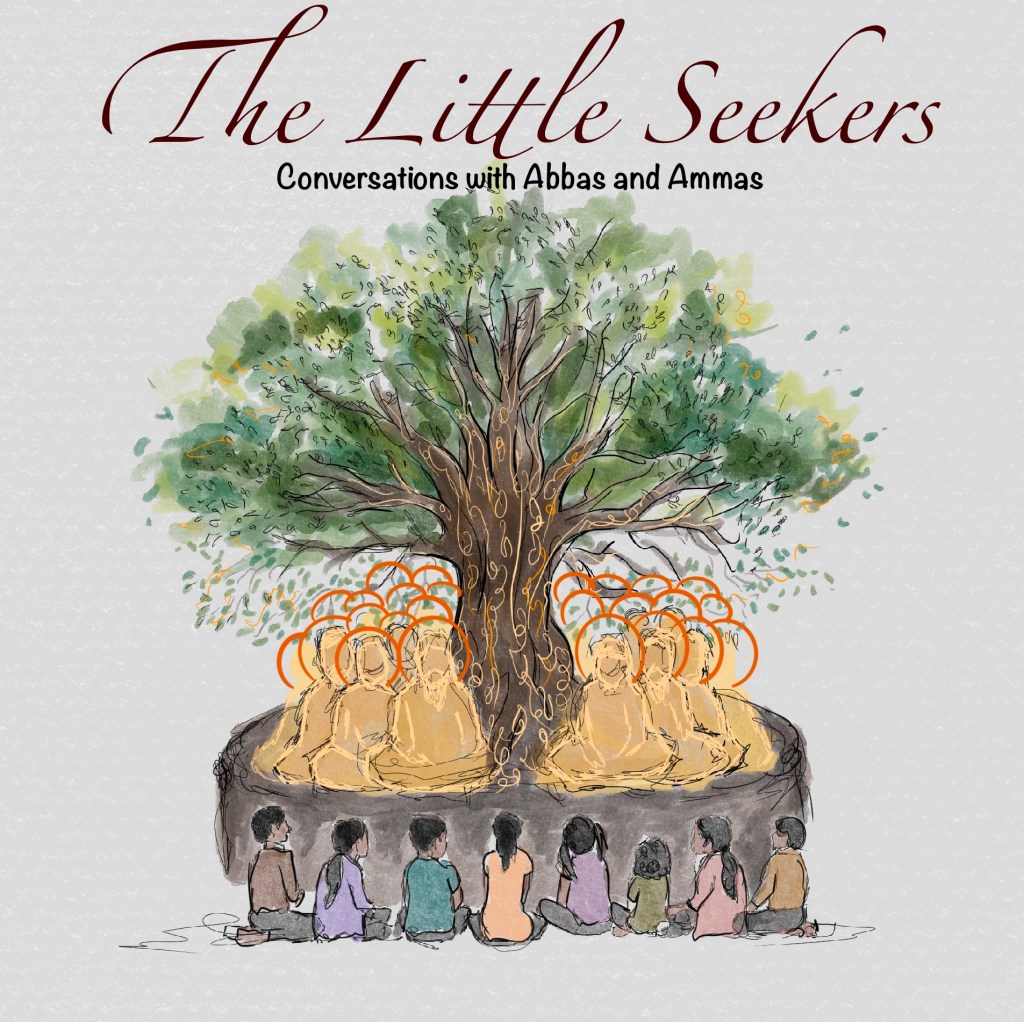
The Little Seekers: Conversations with Abbas and Ammas
Dear Friends,
This is one of my long-awaited personal projects. Today, as we celebrate the feast of two great Fathers of the Church, St. Gregory and St. Basil, I am delighted to share the beginning of a new initiative close to my heart.
I have often reflected on how the timeless wisdom of the Fathers (Abbas) and Mothers (Ammas), including the more recent saints of the Church, has become overlooked in our modern world. Their profound insights hold answers to many of today’s pressing questions, yet these treasures remain distant for many, especially the younger generation. While we celebrate their feasts, we often remain unaware of their teachings. Abbas and Ammas were the titles of early desert fathers and mother who lived in the desert. They were perhaps the first pastoral counsellors. Such a tradition of having Abbas and Ammas is still very much active in many Orthodox Churches. In this project I am using this same title for all the Fathers and Mothers of the Church, ancient and recent both.
I want to bring this wisdom to life in a manner that is simple, engaging, and relatable. That’s when this idea was born: to present life’s concerns as questions asked by children, with the answers drawn directly from the writings, sermons, and testimonies of these saintly souls.
Through “The Little Seekers,” we aim to create a series of illustrations where curious children ask questions that resonate with all of us. The responses, drawn from the original teachings of the Fathers and Mothers, will provide timeless guidance and inspiration. Many of the questions will be real, asked by people from different walks of life, while the answers will reflect the wisdom of these saintly guides.
This is more than just a project for me—it’s a mission to bring ancient wisdom to the forefront of contemporary faith conversations. I hope you all will support and join us on this journey. Stay tuned for the first illustration!
Seeking your prayers, feedback, and encouragement.
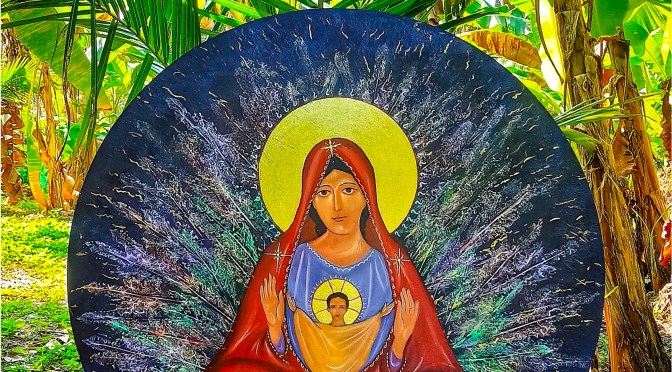
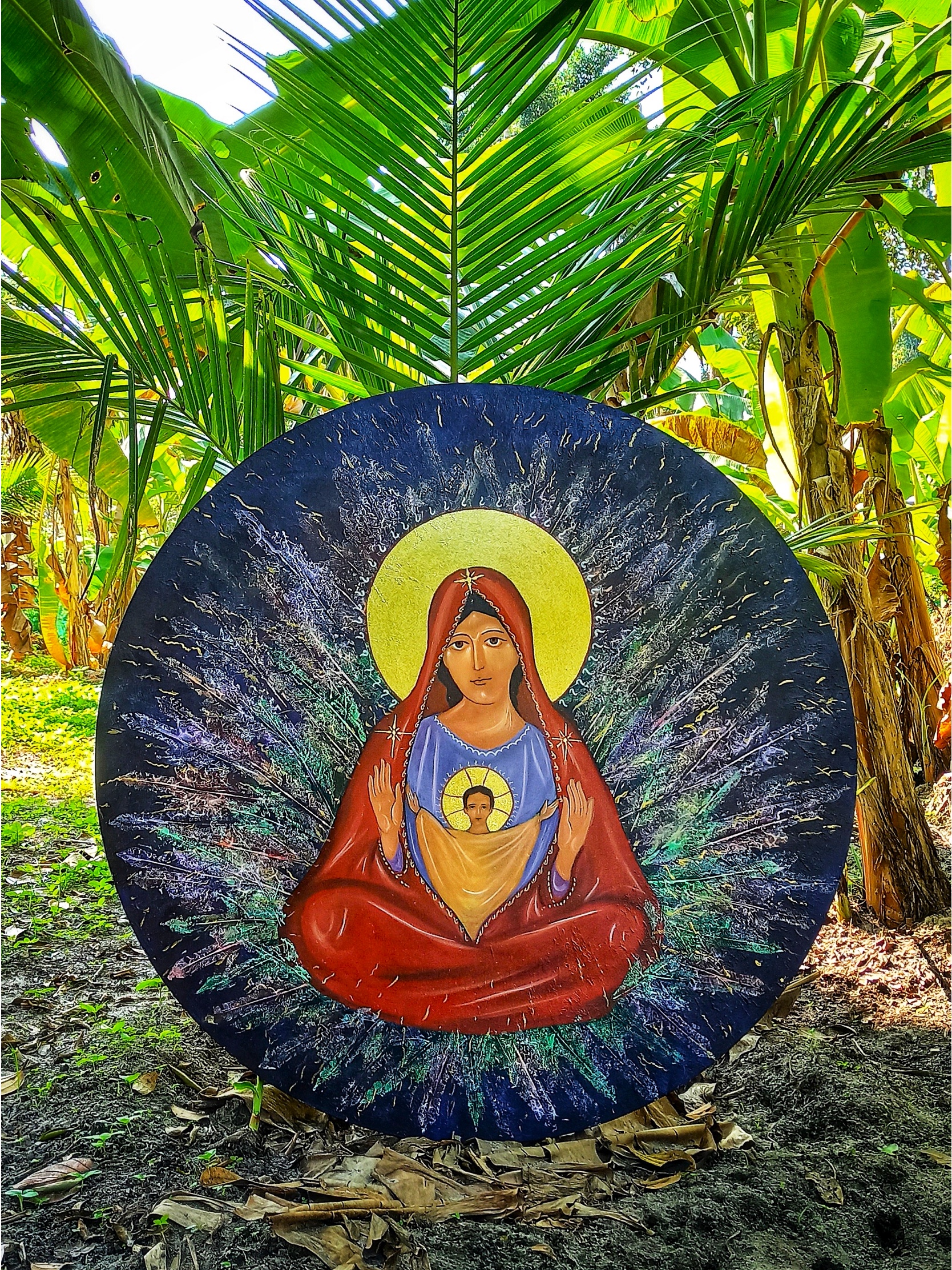
The mystery of Nativity/Christmas, where Virgin Mary becomes the living bush that bore the divine flame—Christ Himself—without being consumed. Just as God’s presence in the burning bush sanctified creation, Christ’s birth renews and illumines the world. The rays in the icon symbolize the light and hope of the Incarnation, dispelling darkness and bringing salvation.
“Prophet Moses saw a fire, Which rested on a bush, and it was Not burned by the flames. Like that bush, the Virgin was Not burned by the flame of the Son of God who dwelt in her.”
This Christmas, may we, like Mother Mary, prepare our hearts to receive the divine flame, allowing God’s presence to sanctify and transform us into vessels of His peace and love, bringing light to those around us.
Icon written by the unworthy hands of Fr Rijo Geevarghese
Sharing a liturgical painting, a visual meditation on the mystery of the Mother Mary bearing Jesus in her womb and the priest bearing the Holy Mysteries in his hands. I was inspired by the sacred moment in the liturgy when, accompanied by candles and Marvahasas, the priest processes westward toward the congregation while holding the Holy Mysteries, praying: ‘May the mercy of our great Lord and Redeemer, Jesus Christ, be upon the bearers of these mysteries, upon those who have offered them, upon those who receive them, and upon all who have labored and have shared and share in them.’
It is profound to see that the qualities of bearing, offering, receiving, labour and sharing the Holy Mysteries are perfectly embodied in the Mother of God, the Theotokos, who bore Christ Himself, and inspires us too to bear, offer, receive, and share in these Holy mysteries through the Holy Eucharist.
Here are some thoughts on these qualities,
Bearing: Mary physically bore Christ in her womb, becoming the vessel through which the Word of God took on flesh. This is mentioned in Luke 1:31, where the angel Gabriel tells her, And behold, you will conceive in your womb and bear a son, and you shall call his name Jesus. (Luke 1:31). By bearing Christ, Mary becomes the first to carry the Divine Word, symbolizing the Church’s call to bear Christ.
Offering: Mother Mary offered Jesus to the world, presenting Him in the Temple, “When the time came for their purification according to the Law of Moses, they brought him up to Jerusalem to present him to the Lord.” (Luke 2:22). This symbolizes her offering of Christ for the redemption of the world, just as the faithful offer the Gifts during the Divine Liturgy.
Receiving: Mother Mary said, ‘Behold, I am the servant of the Lord; let it be to me according to your word.'” (Luke 1:38). Mother Mary received the message of the Incarnation with faith and obedience, as depicted in her response to the angel Gabriel. Expressing on this, St Ephrem writes, “He entered the womb through her ear.“ Through her acceptance, she inspires every believer who is called to receive Christ, through Holy Eucharist.
Labouring and Sharing: Mother Mary’s labor was not just in the physical sense of childbirth but also in her spiritual, emotional, and active participation in God’s salvific plan. She labored in her role as the Mother of Jesus, nurturing Him, and sharing in His ministry. Her presence and actions throughout Christ’s life demonstrate her deep engagement in His mission. At the foot of the cross, she stands as a witness to His sacrifice (John 19:25). This sharing in mystery of Christ exemplifies how every believer is invited to participate in the life, death, and resurrection of Jesus, sharing in His mission of salvation through the Eucharist and the life of the Church.
This sacred moment in the liturgy mirrors the mystery of the Theotokos, who bore Christ, and our call to receive Him in the Eucharist. In this context, St. John Chrysostom’s writes, ‘You do not see Him in a crib but on the altar; it is not the woman that holds Him but the standing priest.’ Similarly, Dionysius Bar Salibi writes, ‘As by the will of the Father and by His Holy Spirit the Word was incarnate from the Virgin without change, so by the will of the Father and the overshadowing of the Holy Spirit, He perfects the bread as His body and the wine as His blood.’
In this painting, I seek to explore the deep mysteries of Orthodox tradition, where the Divine Presence is made manifest both in the Church and in the arms of the Holy Mother.
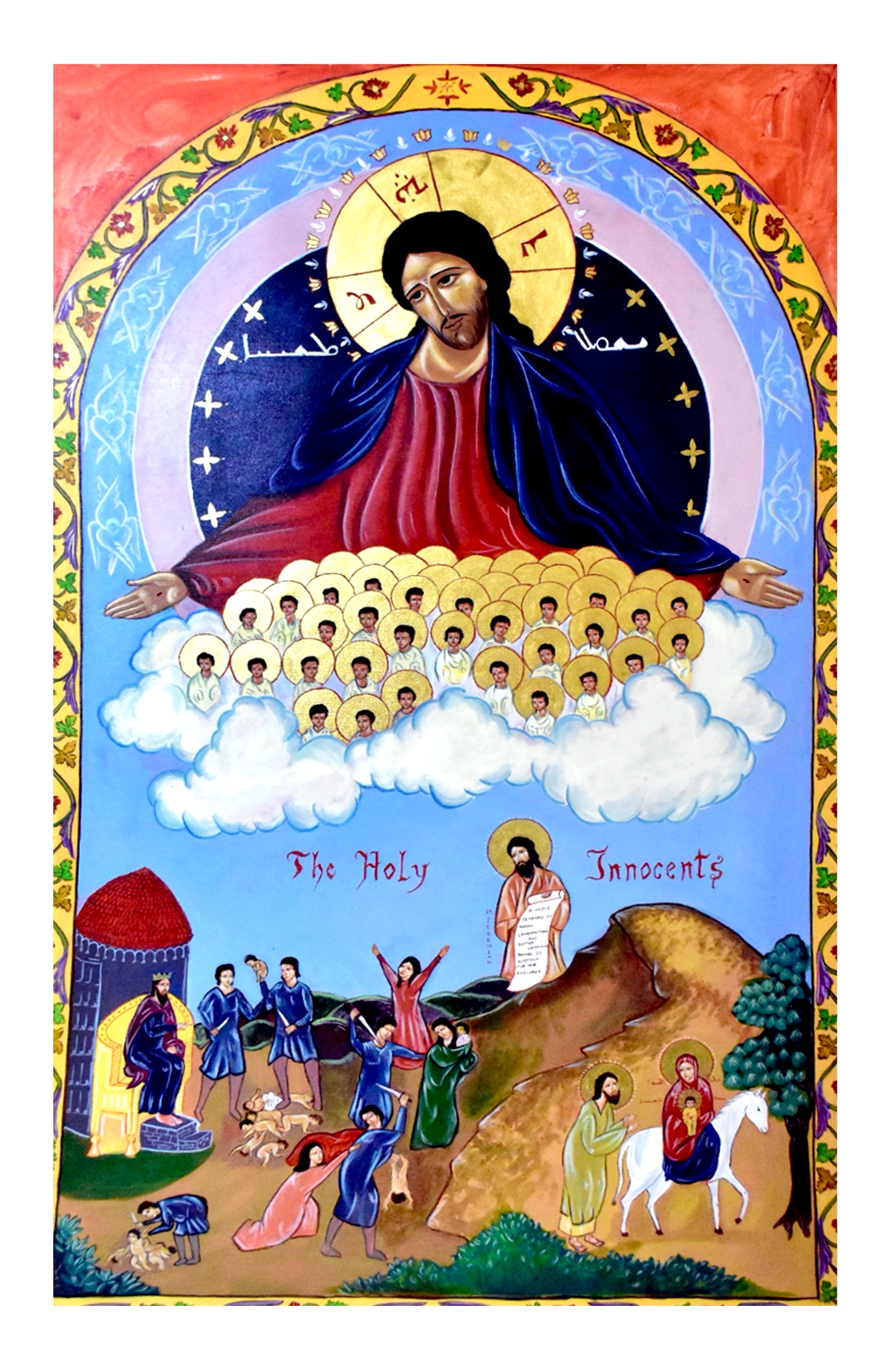
The Orthodox Icon of the Holy Innocents portrays the tragic event described in the Gospel according to Matthew (Matthew 2:16-18) when King Herod, upon learning from the Magi about the birth of a new king in Bethlehem, ordered the massacre of all male children under the age of two in Bethlehem and its vicinity. Here’s a detailed breakdown of the icon’s meaning:
1. Central Depiction: In the centre of the icon, one can see a group of infants or young children, often depicted with angelic faces and halos along with Christ. Christ is shown as embracing them. One can also notice the wounds in Christ’s hands showing His sharing with sufferings of the Children. It also symbolizes the sufferings of innocent victims throughout history across the world. Thus, this icon surpasses the spatial and temporal dimensions and exhibits the present reality as well.
2. MotherMary and Infant Jesus: Mother Mary and the Infant Jesus are depicted in the icon as well along with St Joseph. Their presence emphasizes the context of the massacre, and their flight to Egypt.
3. Prophet Jeremiah: Jeremiah, an Old Testament prophet, is often depicted in the icon because of his prophecy regarding the massacre of the children by King Herod. In the Book of Jeremiah (Jeremiah 31:15), he foretold the weeping and lamentation of Rachel, for her children who were no more. Jeremiah’s presence emphasizes the prophetic aspect of the tragedy. He serves as a witness to the fulfilment of his own prophecy, underscoring the divine foreknowledge of the events and the significance of the Holy Innocents’ suffering in the grand narrative of salvation history.
4. First Martyrdom: In Christian tradition, the Holy Innocents are considered martyrs, even though they did not have the opportunity to consciously profess their faith. Their innocent deaths are seen as a witness to the truth of Christ and the cost of discipleship.
6. Hope and Redemption: Despite the darkness of the event, the presence of the Holy Family in the icon offers hope and redemption. In Christian theology, Jesus’s birth, life, death, and resurrection ultimately bring salvation and victory over sin and death.
7. Prayer and Reflection: For Orthodox Christians, icons are not merely decorative but are considered windows into the spiritual realm. It serves as a focal point for prayer, meditation, and reflection. The Icon of the Holy Innocents invites viewers to contemplate the meaning of suffering, innocence, and the divine presence amidst tragedy.
8. Writings in the Icon:
Meaning of three-letters used behind the Halo of Christ in the Icon: The first letter ܐ and last letter ܬ in Estrangela (on either sides of the halo) means, He is the beginning and end, the Alpha and Omega. The third Estrangela letter (at the top) is the combination of the two letters: ܝ (yodh) and ܗ (heh). These two letters are equivalent to the Hebrew Tetragrammaton יהוה (YHVH), with three points above signifying the three persons of the Trinity, and one point below signifying oneness forming ܞ. This was an ancient symbol used in the Old Syriac text as well as in sacred artforms like icons denoting the Divine name. This Symbol ܞ is scribal abbreviation of the Name of God as revealed to Moses on Mt Sinai (Exodus 3:14).
Syriac script on either side of Christ is Yeshu Mashiho written in West Syriac script. Likewise on either side of Mother Mary is Yoldath Aloho, meaning Mother of God.
Scroll held by Prophet Jeremiah: It resembles the prophecy from the book of Jeremiah 31:15,
“A voice is heard in Ramah,lamentation and bitter weeping.Rachel is weeping for her children.”
The Orthodox Icon of the Holy Innocents communicates a profound message about the nature of innocence, suffering, martyrdom, and the redemptive power of Christ’s love. Contemplating this icon can evoke reflection on the innocence and vulnerability of children, the tragic consequences of human greed and power, and the ultimate triumph of good over evil. It can also inspire empathy and compassion for the innocent victims of violence throughout history and in contemporary times. It invites Christians to remember and honour the memory of the Holy Innocents while also inviting us to care for the vulnerable in society.
This icon is written on canvas (dimension: 6.8 x 4.2ft) by the unworthy hands of Fr. Rijo Geevarghese.

 Graphē