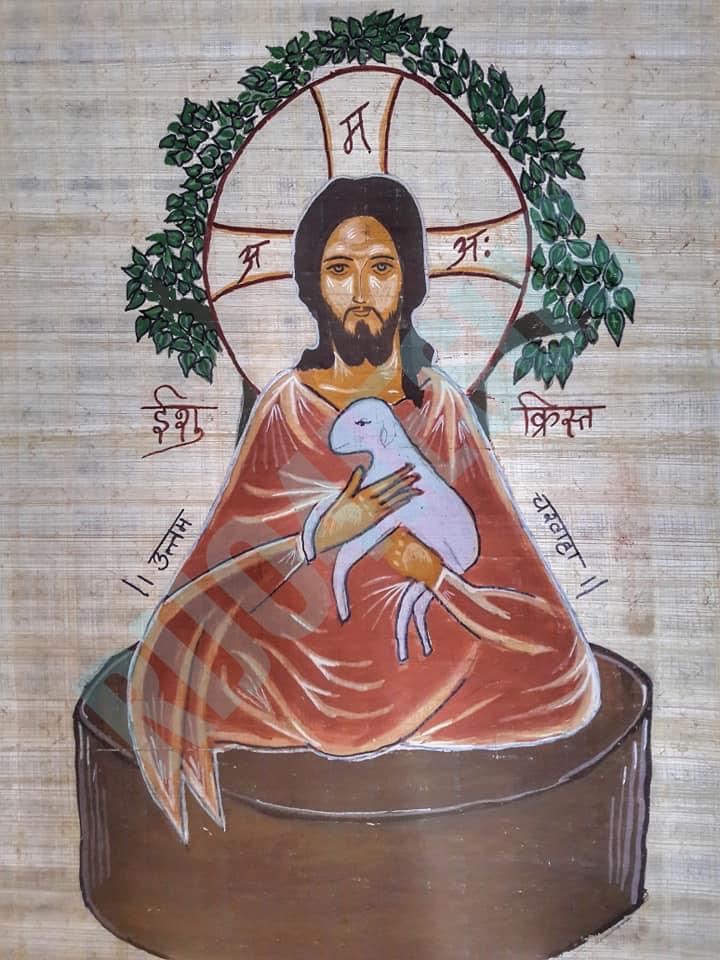
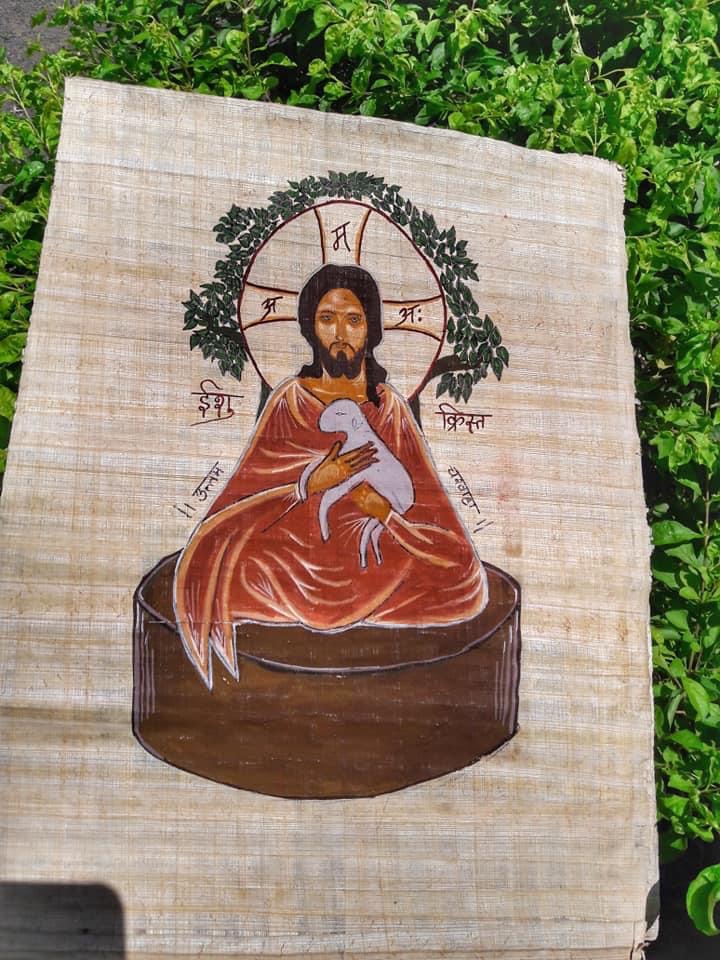
“Uttam Charwaha” On Papyrus (50*30) tempra technique
An indigenous Icon on Papyrus. An attempts in Indian Iconography. Done with traditional tempra technique on hand made papyrus sheet. Showing Christ as the Teacher (Guru) and also as the Good Shepherd (Uttam Charvaha) taking care of his sheep /student(shishya) .
A banyan tree is the national tree of India considered to be symbol of wisdom and teacherhood as it was under this tree that early teachers use to teach in gurukul sampradayam.
The three letters used in the Halo. These three letters are अ, म and अः Here अ and अः are the first and the last letter of sanskrit language as written in Revelation 1: 6 . Actually unlike greek, in Sanskrit the first and the last letter (swara) are same and it sounds the same.
म is the letter representing the mediatorship of Christ (1 Tim 3:10).
Together these three letters forms the symbolic statement “Aadhyanum Madhyanum Anandanum”
Meaning He is the First, He is the Mediator and He is the Last.
Together it also defines the Truth like three letter hebrew word for Truth “emeth” Also in Greek/byzantine icons three greek letters are used ώ Ό Ν (omega, omicron, nu) which also literally means “the being” or more precisely “He who is” or simply “I AM the Exitence”
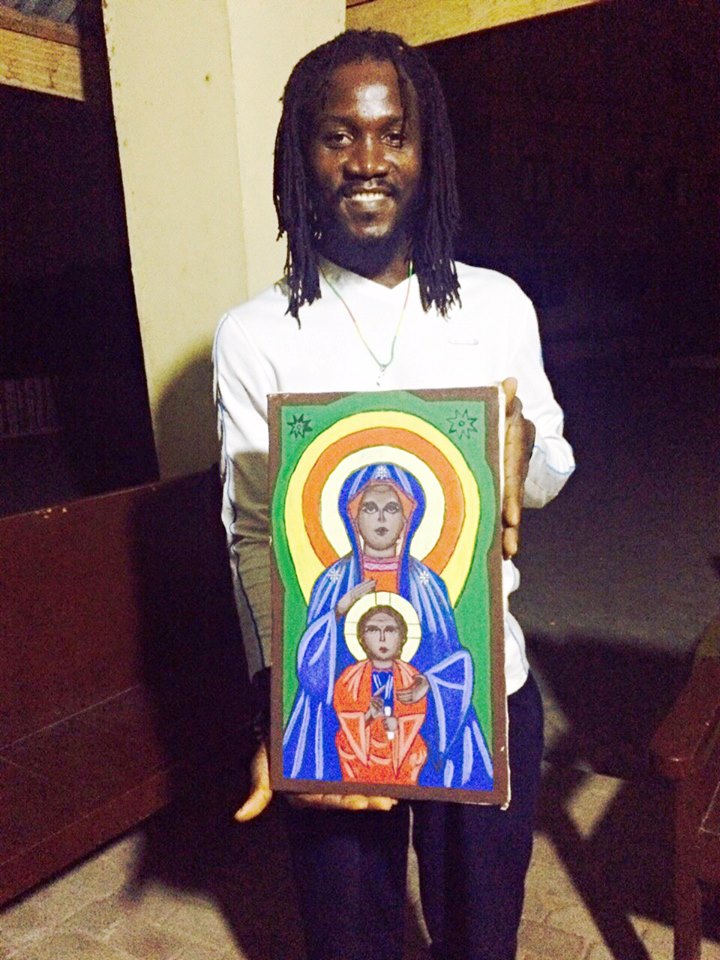
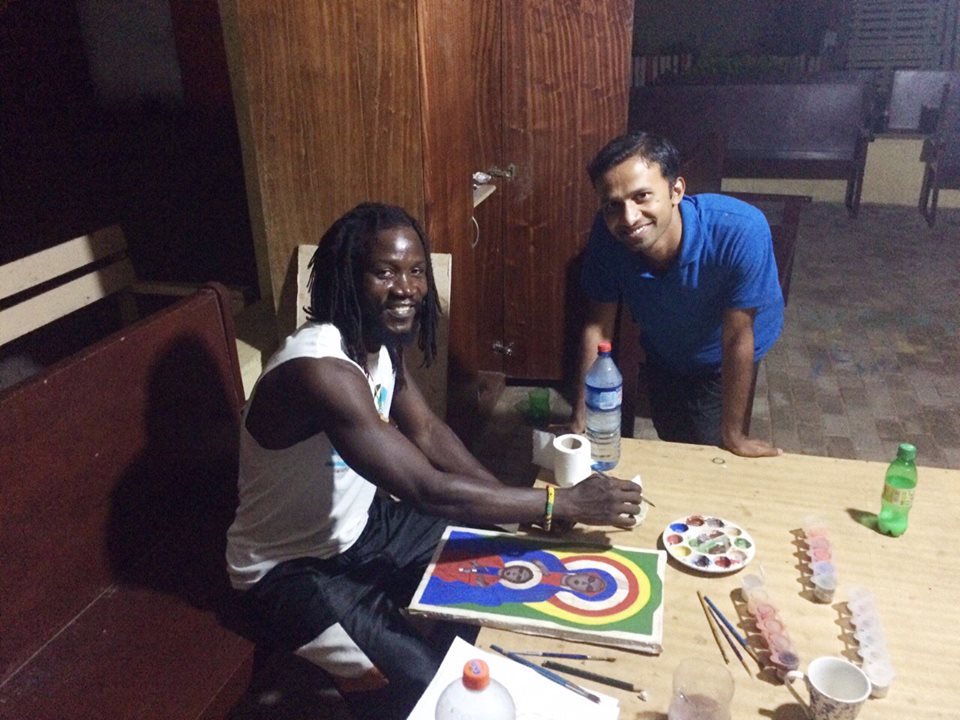
It was great blessing to witness the first Icon by Daniel in a Ghanaian style. Daniel is my Ghanaian friend and is new to Oriental #Orthodoxy. Professionally he is a Wood carver and makes beautiful handmade wooden arts. His inclination towards traditional wood carving art helped him to take interest in Orthodox traditional art. During an Iconography session, Daniel showed a keen interest in learning more about Icons, its meaning and Orthodox concept of #Iconography. And I was more than happy to answer and discuss with him about it.
Followed by Daniel introduced his Ghanaian culture to Iconography. Colors, Symbols especially the #Adinkra symbols (Adinkra are visual symbols, originally created by the Akan tribe of Ghana representing some messages like star symbolizing “God the King”). Colors where generally related to Ghanaian flag which has common colors like other African flags (same like Ethiopian icons)
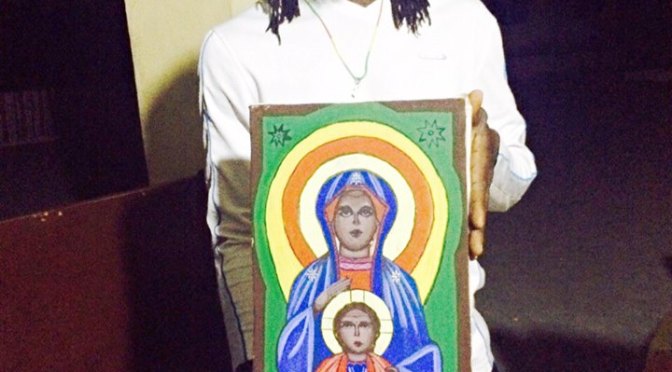
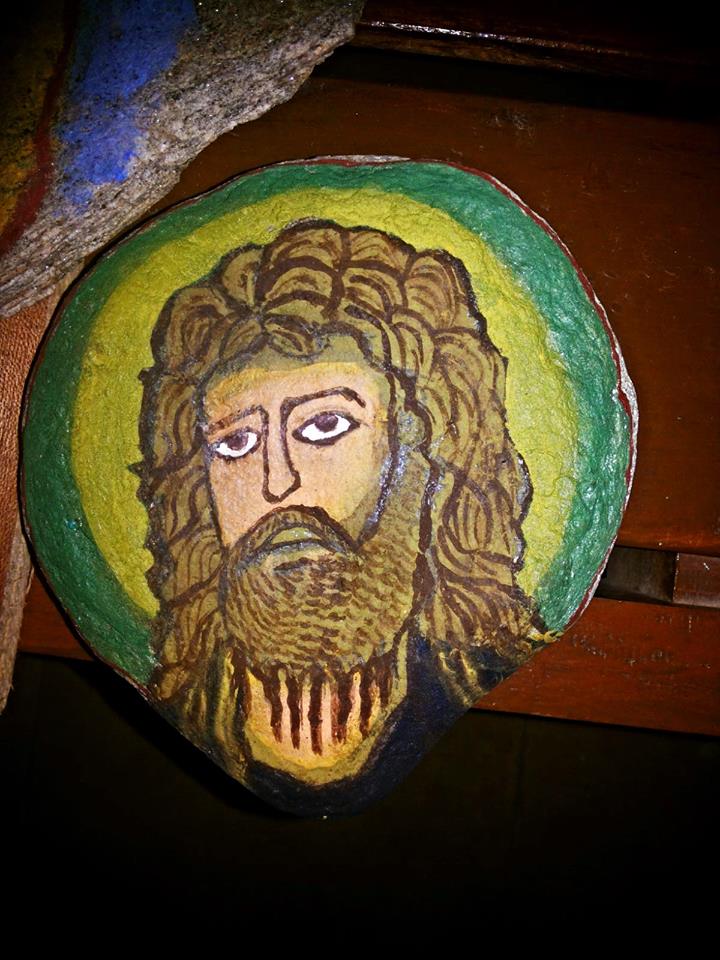
The First Icon made by Daniel is of most Holy Theotokos, which is a 15*30 wooden panel Icon. Daniel’s interest in Iconography is keep growing and he continues to study and write Icons. Followed by he made two more Icons on rock , one of St John the Baptist and other of Elijah.
His story is an inspiration for many. And this story needs to be shared.
May God help him to grow further and share Orthodoxy in Africa. #Orthopost#GhanianIcon
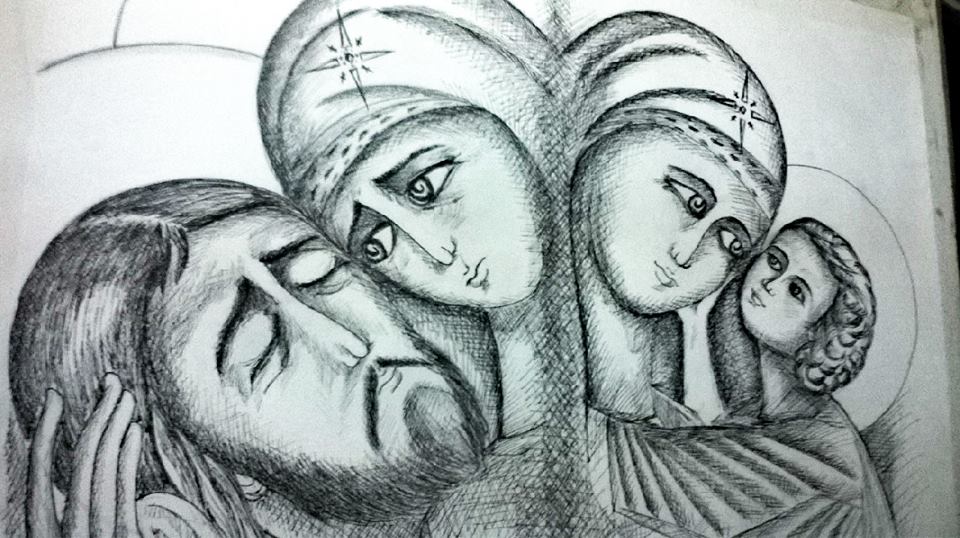
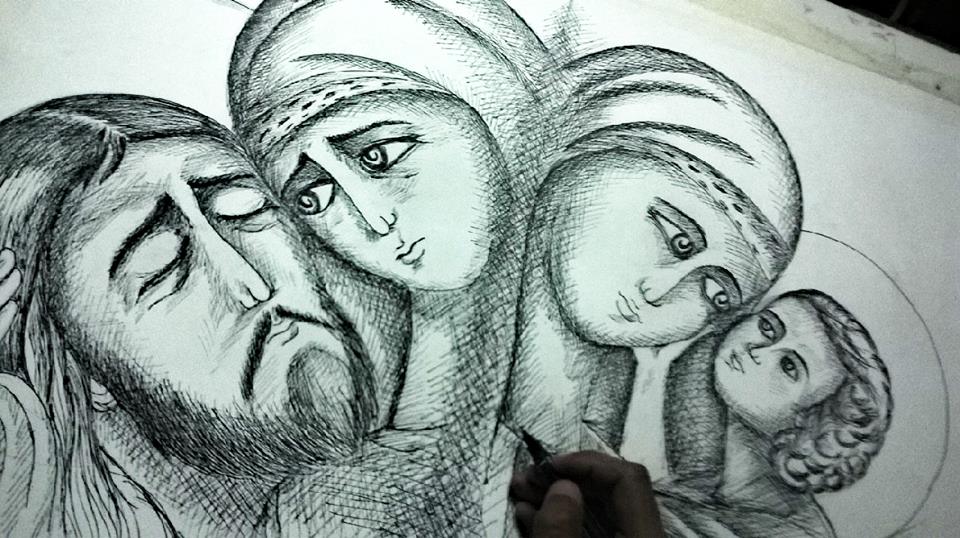
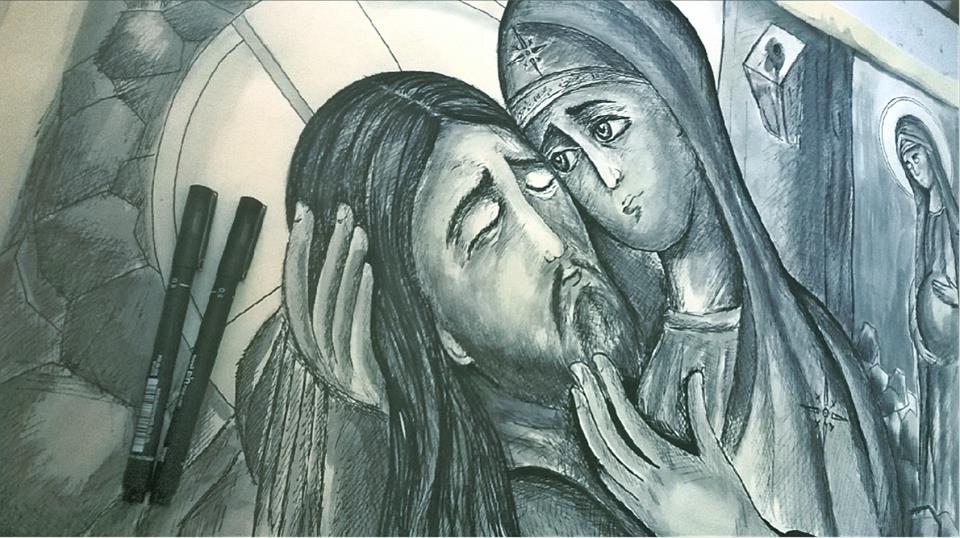
+++ “A mother Receiving her Child”
Slowly, carefully, hand over hand His body lowered down from the Cross. Mary reaches toward him, Not knowing whether to assist Or wait to receive it. Casting around for a place,
Finally, she sits on Golgotha’s cold stone the way she sat in that cold Bethlehem night. But this time its Golgotha’s cold stone. Where they lay him on her lap
A mother Receiving her Child from Cross…..
“That which the word communicates by sound , the painting (Icon) shows silently by representation” St Basil the Great
The liturgical and sacramental life of the Church is inseparable with its visual context. As rightly said, We worship with five senses and one of these five senses is the Sense of vision.
Icons suggest two type of creativity, it is art and liturgical. These two types are complementary and inter related, therefore an Icon is not just a simple image, nor just a decoration, nor just an illustration of Holy Scripture. It is something greater. The Orthodox Church not just sees it as an aspect of Orthodox teaching but the expression of Orthodoxy in its totality. The Icon is one of the manifestations of Holy tradition of Church same like written and Oral tradition. A writing an icon is a process from darkness to light, so material thing ascends to their spiritual ascends. That’s why the process of Iconography is related to liturgy, it is liturgical. Any Icon is symbolical description of the reality therefore the teaching about an Icon is the teaching about Image of God in Man. So every step that an Iconographer demonstrates on board from the step one shows certain reality same like the Holy Liturgy.
According to the tradition and patristic teachings, the context of Holy Gospel and Holy Icons is the revelation, the Incarnation of the Word of God. That is his entry in to the world and the human History, when He became describable. This tradition is followed in parallel with Oral and the written tradition. Both the written scripture and Icon shows the same truth but scripture describe with words and Icon through colors because of which Holy Icons are rightly called “Theology in Colors”.
The festival of Pentecost is of Old Testament origin. It was celebrated to commemorate the giving of the law on Mount Sinai- God Making a solemn covenant with his chosen people and at the same time as a thanksgiving for the first fruit of the earth and the new harvest. It was celebrated as the conclusion of seven weeks and fiftieth day after the Passover and so was called the feast of weeks.
On this day of the revelation of law , Holy spirit descended on his apostles and the disciples by the divine providence and in accordance with the savior’s promise . This descent of the Holy spirit was the making of new covenant by God with the new Israel, the Church.
If all the three person of the Holy Trinity take part in the providential action of God , their manifestation in this action differs from one another. On the day of descent of the Holy spirit on the apostles there was manifested the culmination action of third person of Holy Trinity, consubstantial, undivided yet distinct.
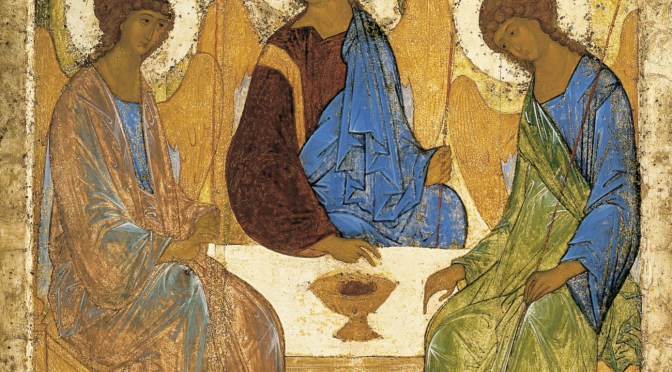
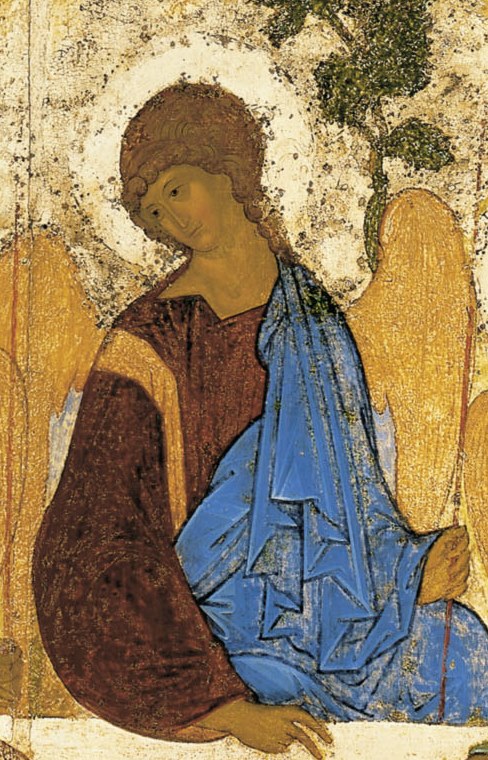
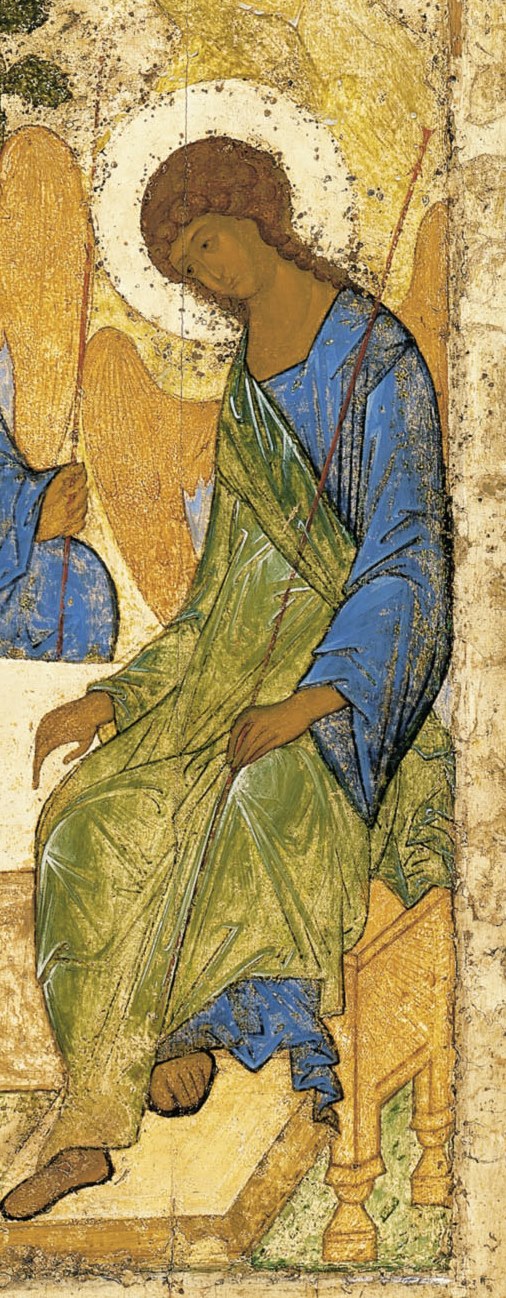
For the iconographical expression , the Orthodox Church has adopted the icon of Holy Trinity representing the biblical sense of three men appearing to our for father Abraham by the Oak of Mambre. To show that they belong to the heavenly world , they depicted as three winged Angel. This image, based on a concrete historical event, show the first appearance of God to man, signifying the beginning of the promise of redemption.
In the 5th Book of “Demonstratio Evangelica” by Eusebius of Caesarea , quoted by John of Damascus in the defence of Holy Icon, which states “God appeared to Abraham by the Oak of Mambre”
We find mention of the fact that an image of Holy Trnity , the form of three Angels , at actual place where three men appears to Abraham, had existed in the most ancient time. The Image of the Trinity , that corresponds most fully to the teaching of the church is to be found in the greatest works, known as Trinity of Rublev, written by him for the monastery of Trinity and St Sergius. The Icon shows Abraham’s house , the Oak and a Mountain, but Abraham and Sarah are absent.
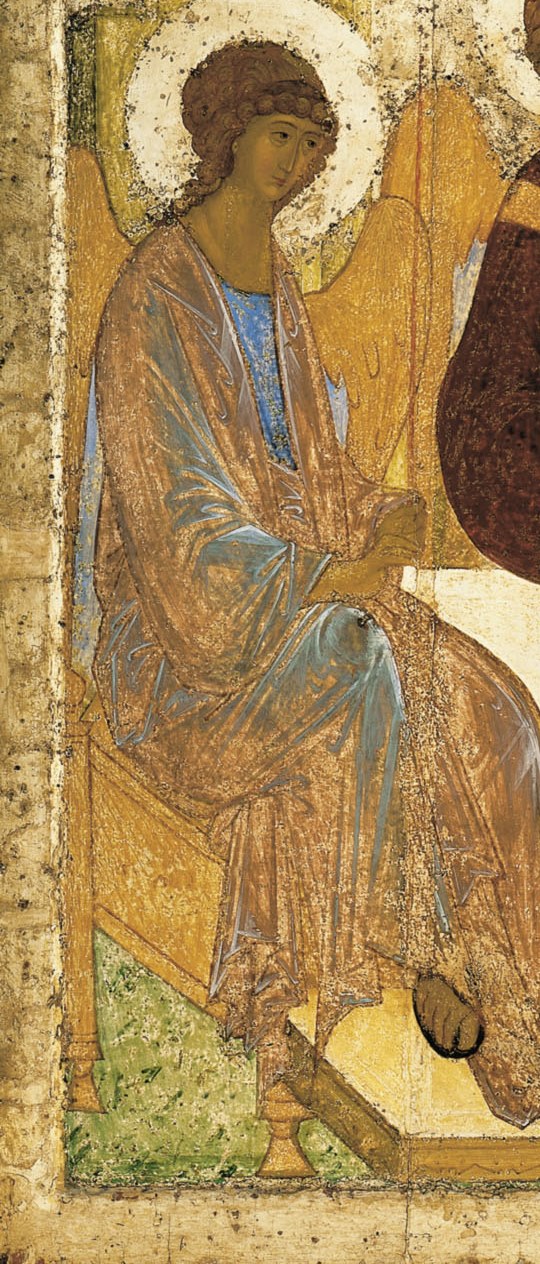
The Angel are grouped in the order from left to right, I Believe in God the father, the Son and Holy Spirit. To the impossibility of depicting the first angel depicted with a pink cloak ,this image of the abode of Abraham on top has a symbolic meaning, the house signifies God’s master plan for creation, while the fact that the house towers above the first angel shows him to be the head (or Father) of this creation. The same fatherly authority is seen in his entire appearance. His head is not bowed and he is looking at the other two angels. His whole demeanor – the expression on his face, the placement of his hands, the way he is sitting – all speaks of his fatherly dignity.
The second and central angel corresponds the precision and clarity of coloring , wjose garment has the customary colours of Son of God, with purple and blue cloak. Finally , the principal colour of third angel is Green , which according to the interpretation of St Dionysius the Areopagite, signifies “Youth, fullness of Power”.
This specifically indicates the properties of the third person of the holy Trinity, renewing all things and giving them life. The subtle harmony and relationship of colors of the Icon of the Holy Trinity is one of its chief attractions.
The almost identical faces and figures of the Angel emphasise the equality of the three Divine Person . The Godhead cannot be represented . It is still the historical scene , which symbolically reveals the unity and trinity of the Godhead by showing its triune action in the world. This is why, despite the likeness of Angels, they are not deprived of individuality , the character of each being definitely expressed as regards his action in the World.
Reference: The meaning of Icon , Leonid Ouspensky, Vladmir Lossky, St Vladmir’s Seminary press
Fresco of St. George the Great Martyr , St George Orthodox (Indian)Syrian Church,Paliakara , Kerala, India
Dec 26 1997, OVBS (Orthodox Vacation Bible School) that was first time I made a sketch of a saint. I didn’t knew much about him, just saw his paintings with the famous setting of him riding a white horse and slaying the dragon. Later did i know that my baptism name was also named after this Holy Martyr.
St George ,Great Martyr George the Victory-Bearer
The Holy Great Martyr George the Victory-Bearer, was a native of Cappadocia (a district in Asia Minor), and he grew up in a deeply believing Christian family. His father was martyred for Christ when George was still a child. His mother, owning lands in Palestine, moved there with her son and raised him in strict piety. When he became a man, St George entered into the service of the Roman army. He was handsome, brave and valiant in battle, and he came to the notice of the emperor Diocletian (284-305) and joined the imperial guard with the rank of comites, or military commander.
Icon of St. George, and his parents, Sts. Gerontius and Polychronia
Of the many miracles worked by the holy Great Martyr George, the most famous are depicted in iconography. In the saint’s native city of Beirut were many idol-worshippers. Outside the city, near Mount Lebanon, was a large lake, inhabited by an enormous dragon-like serpent. Coming out of the lake, it devoured people, and there was nothing anyone could do, since the breath from its nostrils poisoned the very air. On the advice of the demons inhabiting the idols, the local ruler came to a decision. Each day the people would draw lots to feed their own children to the serpent, and he promised to sacrifice his only daughter when his turn came. That time did come, and the ruler dressed her in her finest attire, then sent her off to the lake. The girl wept bitterly, awaiting her death. Unexpectedly for her, St George rode up on his horse with spear in hand. The girl implored him not to leave her, lest she perish. The saint signed himself with the Sign of the Cross. He rushed at the serpent saying, “In the Name of the Father and of the Son and of the Holy Spirit.” St George pierced the throat of the serpent with his spear and trampled it with his horse. Then he told the girl to bind the serpent with her sash, and lead it into the city like a dog on a leash. The people fled in terror, but the saint halted them with the words: “Don’t be afraid, but trust in the Lord Jesus Christ and believe in Him, since it is He Who sent me to save you.” Then the saint killed the serpent with a sword, and the people burned it outside the city. Twenty-five thousand men, not counting women and children, were then baptized.
St. George with scenes from his life, Kremikovtsi Monastery, Bulgaria
The pagan emperor, who did much for the restoration of Roman might, was clearly concerned with the danger presented to pagan civilization by the triumph of the Crucified Savior, and intensified his persecution against the Christians in the final years of his reign. Following the advice of the Senate at Nicomedia, Diocletian gave all his governors full freedom in their court proceedings against Christians, and he promised them his full support. St George, when he heard the decision of the emperor, distributed all his wealth to the poor, freed his servants, and then appeared in the Senate. The brave soldier of Christ spoke out openly against the emperor’s designs. He confessed himself a Christian, and appealed to all to acknowledge Christ:
“I am a servant of Christ, my God, and trusting in Him, I have come among you voluntarily, to bear witness concerning the Truth.”
“What is Truth?” one of the dignitaries asked, echoing the question of Pontius Pilate.
The saint replied, “Christ Himself, Whom you persecuted, is Truth.”
St. George being taken to prison, from Decani Monastery
Stunned by the bold speech of the valiant warrior, the emperor, who had loved and promoted George, attempted to persuade him not to throw away his youth and glory and honors, but rather to offer sacrifice to the gods as was the Roman custom.
The confessor replied, “Nothing in this inconstant life can weaken my resolve to serve God.” Then by order of the enraged emperor the armed guards began to push St George out of the assembly hall with their spears, and they then led him off to prison. But the deadly steel became soft and it bent, just as the spears touched the saint’s body, and it caused him no harm. In prison they put the martyr’s feet in stocks and placed a heavy stone on his chest. The next day at the interrogation, powerless but firm of spirit, St George again answered the emperor, “You will grow tired of tormenting me sooner than I will tire of being tormented by you.” Then Diocletian gave orders to subject St George to some very intense tortures. They tied the Great Martyr to a wheel, beneath which were boards pierced with sharp pieces of iron. As the wheel turned, the sharp edges slashed the saint’s naked body. At first the sufferer loudly cried out to the Lord, but soon he quieted down, and did not utter even a single groan.
St. George being tortured on the wheel, from Decani Monastery
Diocletian decided that the tortured one was already dead, and he gave orders to remove the battered body from the wheel, and then went to a pagan temple to offer thanks. At this very moment it got dark, thunder boomed, and a voice was heard: “Fear not, George, for I am with you.” Then a wondrous light shone, and at the wheel an angel of the Lord appeared in the form of a radiant youth. He placed his hand upon the martyr, saying to him, “Rejoice!” St George stood up healed. When the soldiers led him to the pagan temple where the emperor was, the emperor could not believe his own eyes and he thought that he saw before him some other man or even a ghost. In confusion and in terror the pagans looked St George over carefully, and they became convinced that a miracle had occurred. Many then came to believe in the Life-Creating God of the Christians. Two illustrious officials, Sts Anatolius and Protoleon, who were secretly Christians, openly confessed Christ. Immediately, without a trial, they were beheaded with the sword by order of the emperor.
St. Anatolius the Commander, martyred along with St. George (April 23rd)
Also present in the pagan temple was Empress Alexandra, the wife of Diocletian, and she also knew the truth. She was on the point of glorifying Christ, but one of the servants of the emperor took her and led her off to the palace. The emperor became even more furious. He had not lost all hope of influencing St George, so he gave him over to new and fiercesome torments. After throwing him into a deep pit, they covered it over with lime. Three days later they dug him out, but found him cheerful and unharmed.
St. George put into the pit of lime, and drinking the sorceror’s poison
They shod the saint in iron sandals with red-hot nails, “Run, George, towards the object of our desire!” said the Saint, invoking the Lord’s help. And once again he presented himself, whole and radiant with grace, before the tyrant.] and then drove him back to the prison with whips. In the morning, when they led him back to the interrogation, cheerful and with healed feet, the emperor asked if he liked his shoes. The saint said that the sandals had been just his size. Then they beat him with ox thongs until pieces of his flesh came off and his blood soaked the ground, but the brave sufferer, strengthened by the power of God, remained unyielding.
The Flagellation of St. George, from Decani Monastery
The emperor concluded that the saint was being helped by magic, so he summoned the sorcerer Athanasius to deprive the saint of his miraculous powers, or else poison him. The sorcerer gave St George two goblets containing drugs. One of them would have quieted him, and the other would kill him. The drugs had no effect, and the saint continued to denounce the pagan superstitions and glorify God as before. When the emperor asked what sort of power was helping him, St George said, “Do not imagine that it is any human learning which keeps me from being harmed by these torments. I am saved only by calling upon Christ and His Power. Whoever believes in Him has no regard for tortures and is able to do the things that Christ did” (John 14:12). Diocletian asked what sort of things Christ had done. The Martyr replied, “He gave sight to the blind, cleansed the lepers, healed the lame, gave hearing to the deaf, cast out demons, and raised the dead.” Knowing that they had never been able to resurrect the dead through sorcery, nor by any of the gods known to him, and wanting to test the saint, the emperor commanded him to raise up a dead person before his eyes. The saint retorted, “You wish to tempt me, but my God will work this sign for the salvation of the people who shall see the power of Christ.” When they led St George down to the graveyard, he cried out, “O Lord! Show to those here present, that You are the only God in all the world. Let them know You as the Almighty Lord.” Then the earth quaked, a grave opened, the dead one emerged from it alive.
St. George raising the dead man
Having seen with their own eyes the Power of Christ, the people wept and glorified the true God. The sorcerer Athanasius, falling down at the feet of St George, confessed Christ as the All-Powerful God and asked forgiveness for his sins, committed in ignorance. The obdurate emperor in his impiety thought otherwise. In a rage he commanded both Athanasius and the man raised from the dead to be beheaded, and he had St George again locked up in prison. The people, weighed down with their infirmities, began to visit the prison and they there received healing and help from the saint. A certain farmer named Glycerius, whose ox had collapsed, also visited him. The saint consoled him and assured him that God would restore his ox to life. When he saw the ox alive, the farmer began to glorify the God of the Christians throughout all the city. By order of the emperor, St Glycerius was arrested and beheaded. The exploits and the miracles of the Great Martyr George had increased the number of the Christians, therefore Diocletian made a final attempt to compel the saint to offer sacrifice to the idols. They set up a court at the pagan temple of Apollo. On the final night the holy martyr prayed fervently, and as he slept, he saw the Lord, Who raised him up with His hand, and embraced him. The Savior placed a crown on St George’s head and said, “Fear not, but have courage, and you will soon come to Me and receive what has been prepared for you.” In the morning, the emperor offered to make St George his co-administrator, second only to himself. The holy martyr with a feigned willingness answered, “Caesar, you should have shown me this mercy from the very beginning, instead of torturing me. Let us go now to the temple and see the gods you worship.” Diocletian believed that the martyr was accepting his offer, and he followed him to the pagan temple with his retinue and all the people. Everyone was certain that St George would offer sacrifice to the gods. The saint went up to the idol, made the Sign of the Cross and addressed it as if it were alive: “Are you the one who wants to receive from me sacrifice befitting God?” The demon inhabiting the idol cried out, “I am not a god and none of those like me is a god, either. The only God is He Whom you preach. We are fallen angels, and we deceive people because we are jealous.” St George cried out, “How dare you remain here, when I, the servant of the true God, have entered?” Then noises and wailing were heard from the idols, and they fell to the ground and were shattered.
St. George destroying the idol through his prayers, and saving the princess from the dragon, from Decani Monastery
There was general confusion. In a frenzy, pagan priests and many of the crowd seized the holy martyr, tied him up, and began to beat him. They also called for his immediate execution. The holy empress Alexandra tried to reach him. Pushing her way through the crowd, she cried out, “O God of George, help me, for You Alone are All-Powerful.” At the feet of the Great Martyr the holy empress confessed Christ, Who had humiliated the idols and those who worshipped them.
St. Alexandra the Empress, the wife of Diocletian who was converted through St. George’s martyrdom (April 21st)
Diocletian immediately pronounced the death sentence on the Great Martyr George and the holy Empress Alexandra, who followed St George to execution without resisting. Along the way she felt faint and slumped against a wall. There she surrendered her soul to God. St George gave thanks to God and prayed that he would also end his life in a worthy manner. At the place of execution the saint prayed that the Lord would forgive the torturers who acted in ignorance, and that He would lead them to the knowledge of Truth. Calmly and bravely, the holy Great Martyr George bent his neck beneath the sword, receiving the crown of martyrdom on April 23, 303.
St. George being sentenced by Diocletian and being beheaded, from Decani Monastery
Carrying out the Saint’s desire, his servant took his precious relics back to his country, to Lydda (Diospolis) in Palestine, where innumerable miracles were worked in the great church that was built in his honor.
The burial of St. George
The pagan era was coming to an end, and Christianity was about to triumph. Within ten years, St Constantine (May 21) would issue the Edict of Milan, granting religious freedom to Christians.
The tomb of St. George the Great-Martyr, as it exists today in Lydda, Palestine
The veneration of Saint George enjoyed enormous popularity throughout the Christian world, both East and West. He was chosen to be the protector of countries like Georgia England and India ;thousands of churches have been dedicated to him. There are many churches in the Malankara Orthodox Church that are dedicated in the name of St George which celebrates the feast with big festivities. Puthupally, Chandanapally, Karingachira, Kunnakurudy, Thiruvananthapuram are some of those. In all these churches large numbers gather for this feast. May St. George the Great-martyr, the Trophy-bearer, the Victorious, the Wonderworker intercede for all of us and help us!
Holy Relics of St George in Puthupally St George Orthodox Syrian Church, India
Reference : Icon courtesy of www.eikonografos.com
Images from Decani Monastery,Kremikovtsi Monastery, Paliakara St George Church,
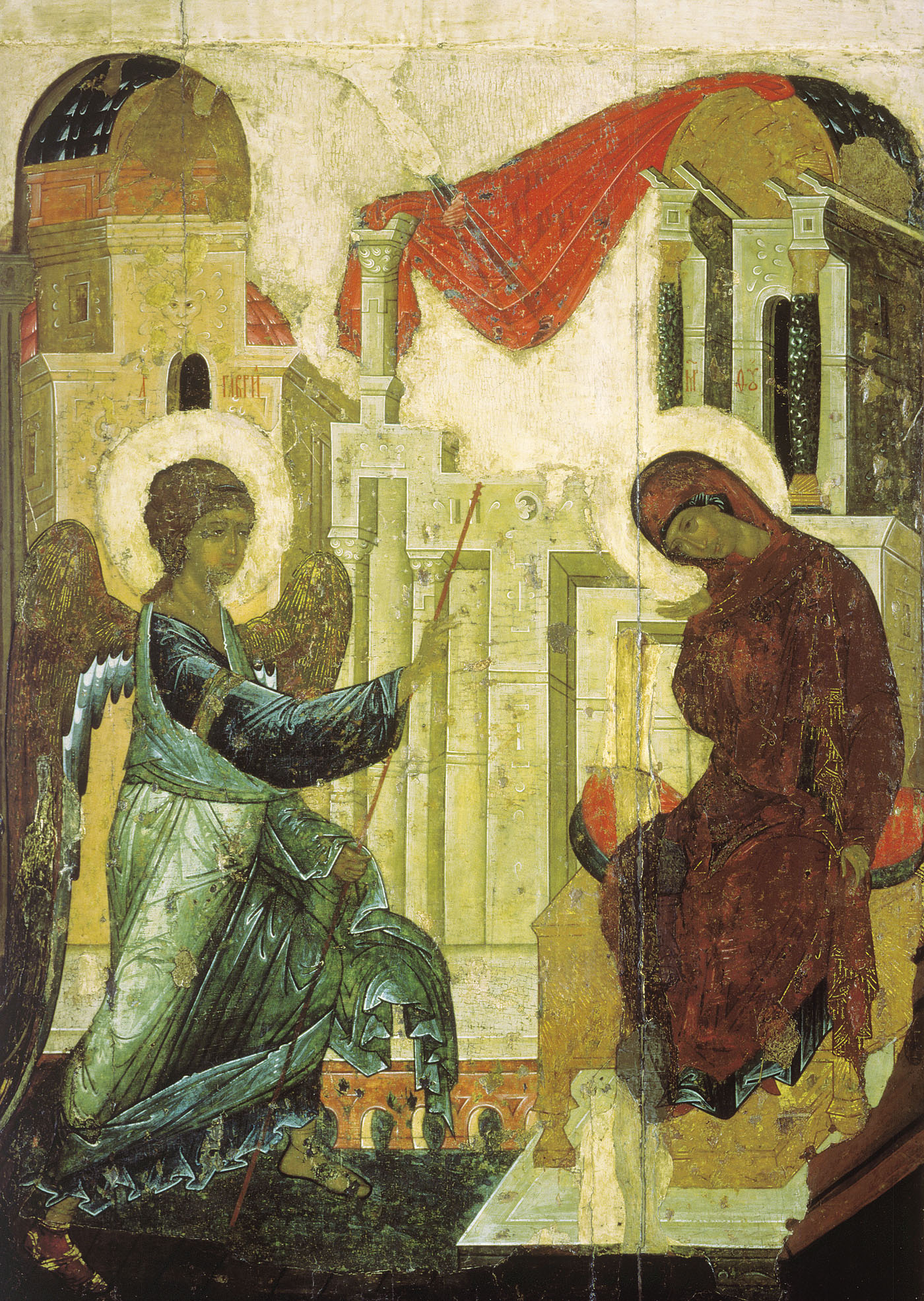
As per Indian Orthodox Church calender today(25th March) is the Feast of #Annunciation.
The Icon of the Annunciation reflects the deep inner joy. It is the joy of the Old testament promise being fulfilled through the incarnation of the Redeemer of the world.
“This day is the beginning of our salvation and the manifestation of the Eternal mystery. The Son of God becomes the son of the Virgin and Gabriel announce the good news of grace. Therefore let us also him cry to mother of God: Hail! Thou that art Full of grace; the Lord is with thee.”
Annunciation from vasilyevskiy by Andreï Roublev
+This Joy is also mentioned in colors. I will try to briefly explain the meaning behind the Icons depicting this joyful event.
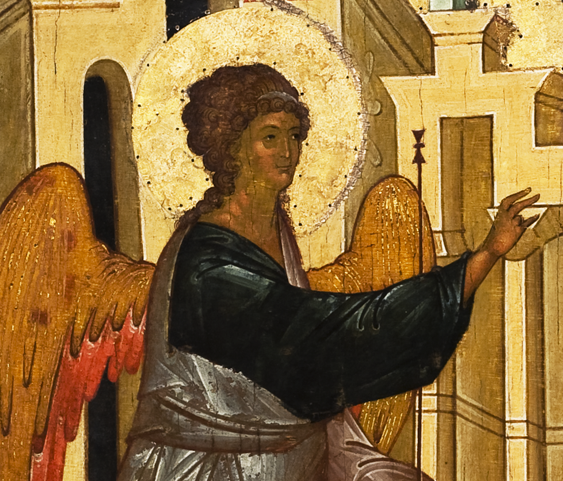
+The majority of Icons depicts Archangel Gabriel in swift motion, he just descended from heaven and looking as a diligent servant intent on carrying out the task given by his Master. His legs are wide apart as though he came running.
+In his left hand he holds a staff, the symbol of a messenger, his right hand strongly moving toward Virgin Mary. He communicates to Her with the glad news from his Master.
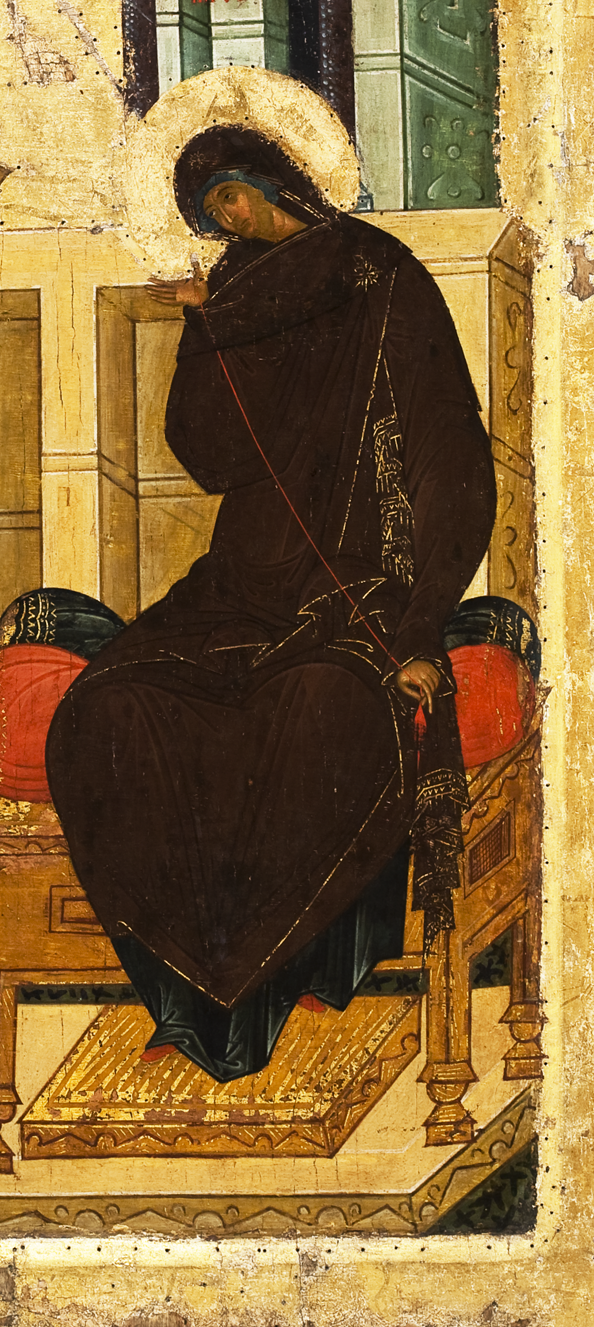
+The Mother of God is depicted either sitting, to emphasise her superiority over Angel or sometimes as standing , as listening to King’s command. As per the rule in Icons, she will be holding a yarn in Her Hands, rarely a scroll. These details are more mentioned in the Proto Gospel of St James.
+The Icon usually emphasizes three moments of the event.
1) The apparition of Angel, his greeting, amazed Holy Virgin. In this icon, in Her surprise, drops the yarn she was spinning.
2) The beginning of our salvation, with the beginning of the fall of man. The fall of our ancestor eve. There Eve along with Adam was casted out of Eden by an angel and here An angel comes in front of New eve for the beginning of our Salvation. Virgin at once does not accept this extraordinary message and recalls the Law of nature:”How this shall be , seeing I know not a man?”
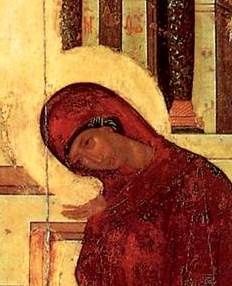
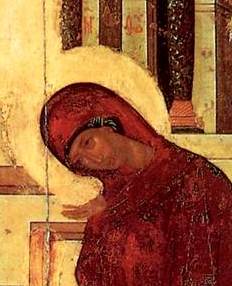
3) Finally, Mother of God bowing Her head , with her right palm to Her breast –the gesture of acceptance , of submission which has decided the fate of the World.
“Behold the handmaid of the Lord; be it unto Me according to thy word.”
+A traditional Iconographical sphere can be scene above , the symbol of high heaven and rays coming through it-the very action of Holy spirit. Same like the Icon of Holy Baptism.
+One of the most attractive feature is the compilation of Unity of action and will of God and His creature. As the festival speaks:
“The angel serves the miracle , the virgin womb receives the Son, the Holy spirit is sent down , the Father send his favor from high(sphere) and the transformation is made………”
#Orthopost
The first icon, the MANDYLION or The Holy Napkin, sometimes called “Made without hands” is said not only to have been an authentic likeness of Christ, but one which Christ Himself willingly produced. It was thus often cited both as proof of the reality of His Incarnation — as it had been in contact with His body — and as justification for the iconophile position that Christ Himself has endorsed the making of His image.
Eusebius of Caesarea
“The Transfer from Edessa to Constantinople of the Icon of our Lord Jesus Christ Not-Made-by-Hands occurred in the year 944. Eusebius, in his HISTORY OF THE CHURCH (I:13), relates that when the Savior was preaching, Abgar ruled in Edessa. He was stricken all over his body with leprosy. Reports of the great miracles worked by the Lord spread throughout Syria (Mt.4:24) and reached even Abgar. Without having seen the Savior, Abgar believed in Him as the Son of God. He wrote a letter requesting Him to come and heal him. He sent with this letter to Palestine his own portrait-painter Ananias, and commissioned him to paint a likeness of the Divine Teacher.
Eusebius does not mention the Mandylion directly, but he does include the letters exchanged between Christ and Abgar, which have come down from us through tradition (the following is the translation from the Menaia (translation by Fr. Ephraim Lash); for the Eusebius’ quote on Abgar and Christ
The existence of The Holy Napkin is first mentioned in the 6th Century. According to one story, Abgar V the Black, king of Edessa (capital of the Turkish province of Oshroene, important Christian and commercial center of the Islamic world until the 13th Century) had fallen ill and begged Christ to come and cure him. Instead of going to visit Abgar, the Lord asked water and a cloth be brought to Him. He washed His Face, drying it with the cloth, and His Divine Countenance was imprinted upon it. Ananias took the cloth and the letter of the Savior to Edessa. Reverently, Abgar pressed the holy object to his face and he received partial healing. Only a small trace of the terrible affliction remained until the arrival of the disciple promised by the Lord. The image was lost and then rediscovered and it remained in Edesa. In the year 944 Edesa was sieged and the Holy Napkin was demanded as a condition for withdrawal. It was then carried in procession to Constantinople, where it was placed in the Sultan’s chapel in the Great Palace. The event is celebrated annually on August 16. Later it is said to have been purchased by King Louis IX of France, in 1247, and taken to Paris and placed in St. Chapelle. It disappeared during the French Revolution.
An old Icon explaining the story of Image of Edessa
The features of Christ’s face on the Holy Napkin are those of the Pantocrator. It is not a bust because it only shows the head and part of the neck; no shoulders are seen. The face is painted as though it is imprinted on a horizontal fringed strip of white cloth, hence the name “napkin.” The earliest surviving example is said to date from the 10th Century and it is at St. Catherine Monastery in Sinai. This icon has no fixed place in the decoration of a church.
The image of the Holy Napkin was also known in the West under the name of The Veil of Veronica. The Veronica story is similar to that of King Abgar: Veronica was a woman who comforted Jesus as He was bearing the cross on the way to Golgotha. She offered Him a piece of cloth to wipe the blood and sweat off His face; later she found that she received a ‘miraculous image. A building along Via Dolorosa in Jerusalem associated with Veronica is today the home of a community of sisters called “The Little Sisters of Jesus.”
“All creative work, be it the spoken word, the written word or the sung word, are essentials in praise and worship, meditation, education, inculturation and evangelism. This also includes art and pictures, which is universal seeing.” Hanna Varghese
Late Mrs Hanna Varghese
You all might have gone through my article called “Face of Christ ,image of edessa”. It tells the story of Hanna or Ananias (royal painter of King Abdgar) and how the miraculous image of Christ was portrayed.
Malankara Orthodox Syrian Church was blessed by an another royal artist with the same name Mrs Hanna Varghese.
Hanna Varghese was born on April 7, 1938, she was one of three children of accountant Ikareth Cheriyan and Kunjamma Parayil, and showed promise in art from a young age. She attended a two-year teachers training course at Kirkby College in England, where she earned a distinction in art.
“saviour”
She returned in 1958 to begin her career in teaching. After two years with a government school in Sabak Bernam, she married George Varghese. Hanna quit teaching after 14 years in the profession to concentrate on her growing family. This brought the best out of her creative and natural abilities. The Last Supper, The Good Samaritan, The Moment of Truth and Calming the Storm, to name a few, are considered “master paintings”. These were essentially paintings with acrylic on canvas and batik-dyeing in fabric. About batik, Hanna has been quoted as saying:
“Hosanna”
“There is an element of surprise and wonder in dyeing. The colour is deep when the fabric is wet. When it dries it takes on a lighter shade. Finally, the result of colour on colour is amazing when a new hue emerges.”
She began to strongly express her faith, spiritual thoughts and experiences with lively biblical images. Inspired by the artwork of many Asian Christian artists in the Image magazine, Hanna had her own work featured in too. She became a coordinator of the Malaysian Christian Artists Fellowship and was vice-president of the Asian Christian Art Association from 1998 until 2003.
She aslo served the Overseas Ministries Study Centre (OMSC) at New Haven, Connecticut, in the United States as resident artist during the 2006-07 academic year and her paintings were exhibited at Yale Institute of Sacred Music, Princeton Theological Seminary and the OMSC. It was while Hanna was in the US that she was diagnosed with cancer. Throughout her illness she was still working on her paintings and designing theme posters for important Christian conferences in Asia. She entered heavenly abode on June 12, 2009 aged 71.
“calming the storm”
Through her gift of art and the love, Hanna touched many people, her church, the ecumenical movement and organizations:
World Council of Churches
Christian Conference of Asia
Asian Christian Art Association
Overseas Ministries Study Center- New Haven, USA
Hanna preached the gospel through the best way she knew. Once during an interview she said:
“As a child I loved drawing. We had a Bible storybook at home with vivid illustrations which left a lasting impression on me. Although I could not read at that time, the pictures made sense to me. Image is the tangible form of our thoughts and our spoken and written words. I could read into the pictures and interpret what they were saying. The images I make today are windows for others to look into my interpretation. That is my witnessing.”
Batic art
Hanna has taught us that life can be made beautiful if we can use the gifts God has given to us to touch other lives. Just as her paintings communicate the love of God and blessed so many, she would wish that we so live to bless others.
When asked What advice would you give to Christians and the global Church about using art for evangelism?
She said: All creative expression, be it the spoken word, the written word or the sung word are essentials in evangelism. Let us not forget the rightful place of visual images too. Art is the “seeing” word, the tangible word. Remember God “created” and “it was good.” Only when we perceive the beautiful can we say, “The heavens are telling the glory of God and the firmament proclaims his handiwork” (Psalm 19:1). Christian communities should look into the possibilities [of including] art in their praise and worship, education and veneration (as in icon).
Art is the expressive cry of the soul. All of us have that urge in one form or another. Discover it; nurture it.
Remembering her with love
Rijo Geevarghese
rijo4iesus@gmail.com
COMMUNION OF THE MOTHER OF GOD (Manna Makalkayi)
The Old Testament is filled with the stories of people and events that builds up the history of God’s chosen people, Israel. But we may often wonder, “What do all these stories mean?” We are also told that in Christ, the whole Bible holds together. How can we see our Lord Jesus Christ in the people, events, and prophecies of the Old Testament?
We can find many symbols representing Holy #Theotokos (Mother of God) in Old testament. These symbols are also mentioned in Madyastha Prarthanagal, Theotokias ( Coptic Midnight Praise), as well as other hymns chanted during the Divine Liturgy. Lets understand these symbols. #Orthopost
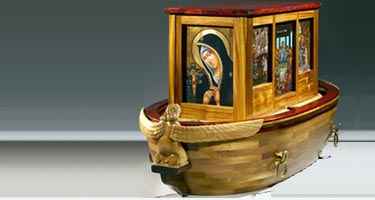
Mary , the noah’s ark
The Ark of Noah (Genesis 6-9) In his first epistle, Saint Peter writes that by Noah,
“…eight souls, were saved through water. There is also an anti type which now saves us – baptism” (1 Peter 3:20-21).
Saint Peter makes the connection between the event of Noah’s Ark, and the salvation in Christ through baptism. Noah, then, is a type of Christ, while the ark itself symbolizes Saint Mary. Just as the ark received Noah and became a means of saving the world, Saint Mary received God the Word and gave Him the human body by which He died for our salvation.
Icon with Jacobs ladder , above a depiction of Theotokos
The Ladder of Jacob (Genesis 28:10-17)
When Jacob fled from his brother Esau, he saw a vision of a ladder that was set upon the earth with its top reaching to heaven. The Lord stood above this ladder and the angels of God ascended and descended on it. The Lord stood above this ladder expressing His intent to descend on it. It is through His incarnation that the Lord descended from heaven and manifested Himself to us. The ascending and descending of angels point to their ministering to Saint Mary. Archangel Gabriel announced the birth of our Savior to Saint Mary (Luke 1:26-39). An angel also appeared to Saint Joseph telling him not to be afraid, but to keep Saint Mary at his house (Matthew 1:18-25). The angels also led the Holy Family as they fled from Herod (Matthew 2). Jacob’s ladder, therefore, is a type of Saint Mary, who tied heaven and earth together through the body of the Lord which was taken from her. She also intercedes on our behalf, carrying our prayers to our Lord in heaven.
Mary. the Burning bush(coptic Icon)
The Burning Bush (Exodus 3)
While tending to the flock of his father in law, Moses saw a burning bush. Although it was burning with fire, the bush was not consumed. The burning bush represents Saint Mary who carried the fire of the Lord’s divinity without her wo
A tabernacle
mb being consumed. After she gave birth to the Lord, Saint Mary’s virginity also remained sealed; that is, it was not consumed.
The Tabernacle
In the Book of Exodus, we read of the building of the Tabernacle. God spoke to Moses saying, “I will consecrate the tabernacle of meeting and the altar… I will dwell among the children of Israel and be their God” (Exodus 29:44-45). The Tabernacle is likened to Saint Mary, for the Lord dwelt in her.
A replica of Golden pot of Manna
The Pot of Manna (Exodus 16)
After their escape from Egypt, the children of Israel ate manna in the wilderness for forty years. God spoke to Moses saying, “Behold I will rain bread from heaven for you…Take a pot and put an omer of manna in it, and lay it up before the LORD, to be kept for your generations” (Exodus 16:4,33). This pot was then kept in the Ark of the Covenant along with the tablets on which the Ten Commandments were written, as well as the rod of Aaron. Our Lord Jesus Christ also spoke to the Jews saying, “I am the bread of life. Your fathers ate the manna in the wilderness, and are dead. This is the bread which comes down from heaven, that one may eat of it and not die. I am the living bread which came down from heaven. If anyone eats of this bread, he will live forever; and the bread that I shall give is My flesh, which I shall give for the life of the world” (John 6:48-51). If the manna is a type of Christ, Who is the bread of life coming down from even, then the pot made of pure gold, which carried the manna, is a type of the pure Saint Mary, who carried the Lord in her womb.
“At your hand stands the queen in gold from Ophir” (Psalm 45:9).
This is why in her Icon, she is portrayed at the right hand of Christ our Lord and King.
Aaron’s blossoming rod
The Rod of Aaron (Numbers 17:1-8)
In Numbers 16, we read of Korah who rebelled against God, Moses, and Aaron and claimed for themselves the priesthood. The Lord wished to reveal to the people of Israel to which tribe the priesthood rightly belonged. Each tribe presented a rod and placed it in the tabernacle of meeting. Aaron’s name was placed on the rod of the tribe of Levi. The rod of Aaron sprouted and put forth buds, producing blossoms and yielding ripe almonds, as a sign that God had chosen the tribe of Levi. The barren rod which blossomed without planting or watering is a symbol of Saint Mary, who, being a virgin, brought forth the Fruit of Life. It is also a symbol of the human soul; although weak in itself, through God’s grace can bring forth the fruit of the Spirit.
The closed gate of temple, Jerusalem
The Gate of Ezekiel
Ezekiel the prophet said, “Then He brought me back to the outer gate of the sanctuary which faces toward the east, but it was shut. And the Lord said to me, ‘This gate shall be shut; it shall not be opened, and no man shall enter by it, because the Lord God of Israel has entered by it; therefore it shall be shut” (Ezekiel 44:1-2). This gate, which Ezekiel saw, is a type of Saint Mary. She is the gate through which the Lord entered. After she gave birth to Him, the gate remained shut; that is, she remained a virgin and no other man entered into her womb.
Censer
The Censer
The golden censer, used in Church worship, is also a type of Saint Mary. The live coal in the censer, according to Saint Cyril the Great, points to the unity of the divinity and humanity of Christ. Just as the censer carries the fiery coal, so also the Lord dwelt in the womb of the Virgin. The aroma of incense coming from the censer is likened to the sweet-smelling sacrifice of our Savior. As the church chants in the Hymn of the Censer, “The golden censer is the Virgin. Her aroma is our Savior.”
You prepared the world to receive You, now also purify our hearts to receive You always.We ask this through the intercessions of Your holy and pure mother, Saint Mary.
Amen.
*Do mail /comment, if you have any other symbols for Mother Mary.










 Graphē