Category Archives: Coptic

Desert Mothers and Fathers

Who were the Desert Mothers and Fathers?

In the fourth century, a few men and women in Egypt, Syria, Palestine, and other areas of the Middle East and Asia Minor felt a calling. They decided to follow it. They chose to leave their possessions and their families. They gave up their everyday life for an existence of extreme simplicity in the desert. They made their homes sometimes in caves, or in small huts or “cells” (kellia) which they built themselves. They lived on bread, water, and salt. They also consumed small amounts of herbs or vegetables. They earned their living from simple manual work such as weaving linen, or making baskets and ropes. They lived with the barest essentials. This allowed them to focus on what really mattered to them. Antony was one of the most famous pioneering desert fathers. One day in church, he heard a reading containing the words of Christ: “Go and sell everything you have, give the money to the poor, and come, follow me.” He heard these words as a personal call. He felt they were addressed to him. Soon he moved into the desert to spend the rest of his life in prayer and contemplation. He died in the year 356 at the age of over a hundred, after having inspired a large number of disciples.[1]

More and more people were attracted to this life in the desert. A few chose to live in solitude, meeting with other people only occasionally; others would gather as small groups of disciples to live near an elder. In some places, larger settlements grew up in the desert. The most important ones were Nitria, Scetis, and another known as Kellia. All these were situated in the North of Egypt. In the south of Egypt, Abba Pachomius gathered his disciples into a tightly-knit community, and so the first monastery came into existence.

They referred to each other as “brother” or “sister”. However, the words Abba (Father) or Amma (Mother) came to be used as a term of respect. These terms showed affection for the most experienced and wisest of them. A little later, more specific terms came into use: “monk” and “nun”, or, for those who lived alone, “hermit” or “anchoress”.

Many of the desert fathers and mothers took great care of the parts of the desert where they lived. They cultivated the land and made it fruitful. In some places, where they lived in community, this made it possible for them to provide for the poor who lived nearby or even to send grain to the cities for the relief of the destitute

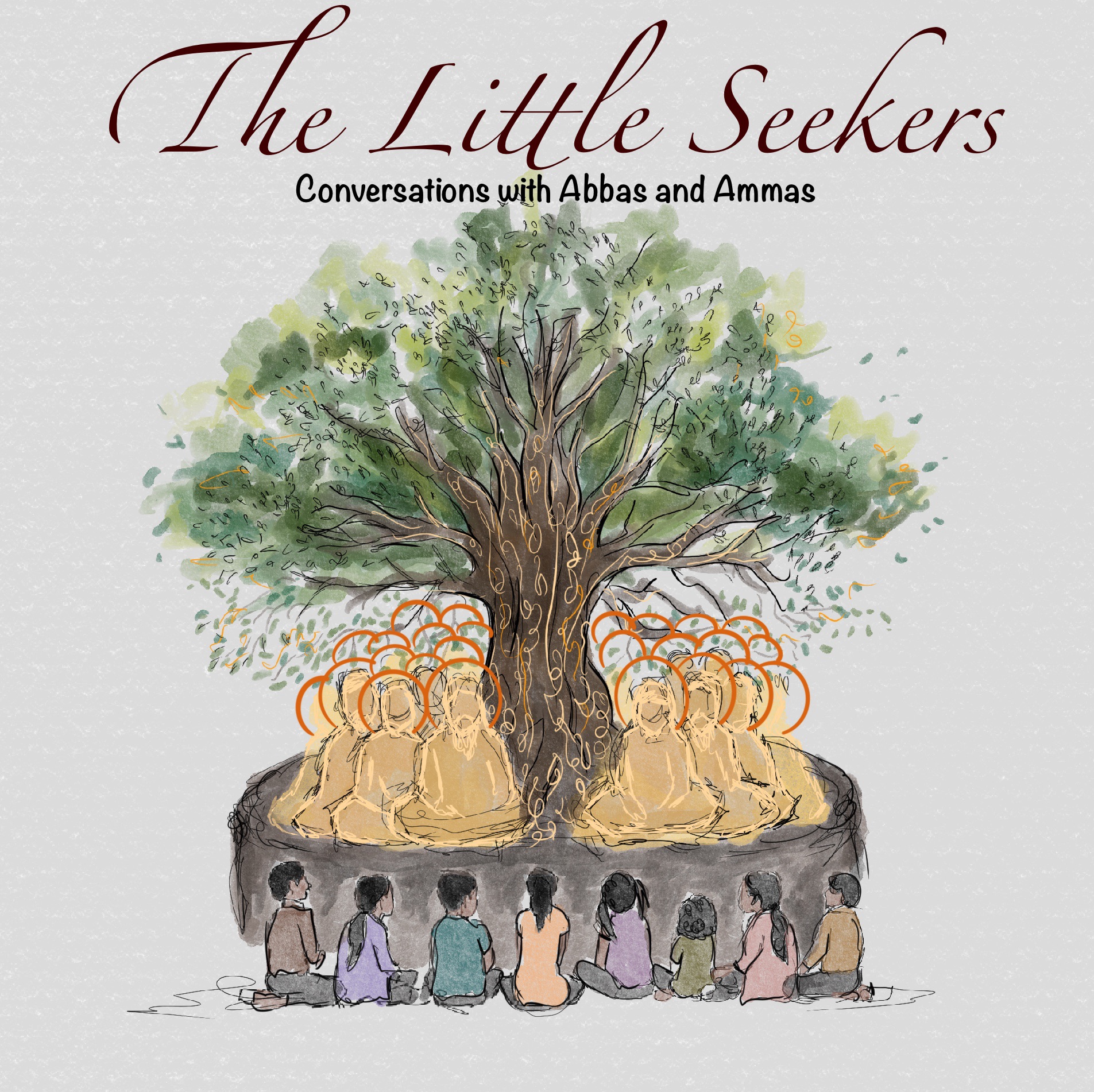
The main concern of the desert fathers and mothers was the life of the heart: they wanted to be with God. When someone lives alone, they spend a lot of time in silence. They become aware of all the different thoughts and feelings that inhabit human nature. These include both good and bad aspects. Without help, it is easy to become confused. It can be difficult to distinguish what is life-giving from what is destructive. It is also hard to determine what really comes from God and what is just imagination. So the practice soon arose of sharing one’s thoughts and way of life with an elder. The elder’s experience was invaluable in discerning what was right from what was misleading. They helped differentiate the authentic from the false. Key moments from the conversations between an elder and their disciples were remembered and later written down as the “Sayings” (Apophthegms). They contain a remarkable blend of wisdom, challenges, psychological insight, realism, and humor.
Desert Mothers

While the Desert Fathers have often been the focus of early monasticism, the contributions of the Desert Mothers are equally significant, providing unique insights into early Christian spirituality and ascetic practice.

The Desert Mothers emerged alongside Christian monasticism as Christianity became the state religion of the Roman Empire. Seeking a deeper and more austere religious life, many believers withdrew to the desert’s harsh environment for solitude and focus on God. Known as “Ammas,” these women defied societal norms and domestic expectations, leading lives of discipline and becoming spiritual leaders and mentors.

Amma Sarah

Amma Sarah is one of the most well-known Desert Mothers. She lived by the river Nile for over sixty years, dedicating her life to prayer and asceticism. Amma Sarah is remembered for her profound wisdom and spiritual strength. She famously said, “If I prayed that all men should approve of my conduct, I should find myself a penitent at the door of each one. I shall rather pray that my heart may be pure towards all.” Her teachings emphasized the importance of inner purity and the avoidance of judgment. She resisted temptation with steadfast resolve, demonstrating that the path to spiritual enlightenment requires unwavering commitment and self-awareness.

Amma Syncletica

Another prominent Desert Mother, Amma Syncletica, hailed from a wealthy Alexandrian family but chose to renounce her riches to live an ascetic life. Her teachings, recorded in the Apophthegmata Patrum, highlight the struggles and rewards of the monastic life. She taught about the importance of perseverance, comparing the spiritual life to a flame that needs continuous fuel to keep burning. Amma Syncletica also spoke about the trials and tribulations that come with a life dedicated to God, advising her followers to remain vigilant and persistent in their spiritual journey. One of her famous sayings is, “Just as treasure is discovered through toil and pain, so also is spiritual health gained through suffering.”

Amma Theodora

Amma Theodora was a spiritual guide known for her wisdom and compassion. Her teachings often revolved around the theme of divine mercy and the importance of humility. She taught that one should always trust in God’s mercy and never despair, no matter how grave their sins. Amma Theodora offered practical advice for spiritual growth, emphasizing that one must constantly strive for humility and self-awareness. She said, “Let us strive to enter by the narrow gate. Just as the trees, if they have not stood before the winter’s storms, cannot bear fruit, so it is with us. This present age is a storm, and it is only through many trials and temptations that we can obtain the kingdom of heaven.”

Amma Melania the Elder

Amma Melania the Elder was an influential figure who established monastic communities and was deeply involved in theological discourse. She traveled widely, visiting the deserts of Egypt and engaging with both Desert Fathers and Mothers. Her life reflects a dedication to fostering monasticism and encouraging others in their spiritual journeys. Amma Melania’s legacy includes not only her own ascetic practices but also her role in supporting and mentoring others in the monastic life.

Amma Alexandra

She is known from the Lausiac History[2] written by Palladius[3]. He recounts that Alexandra was a servant-girl before her life in the desert; she lived as a recluse in a former Egyptian tomb, spending her whole time praying, spinning flax, and meditating on the Bible.

Amma Talida or Talis

She is mentioned by Palladius in his Lausiac History he met her when she was very elderly, having lived for eighty years in her community with sixty other women, who loved and respected her greatly. Her long experience of self-discipline gave her great freedom.

The Desert Mothers were pioneers of Christian asceticism who left an indelible mark on early monasticism. Figures like Amma Sarah, Amma Syncletica, Amma Theodora, and Amma Melania the Elder exemplify the profound spiritual wisdom and resilience of these women. Their lives and teachings continue to inspire and challenge contemporary Christians, offering valuable lessons on humility, perseverance, and the pursuit of a deeper relationship with God. The legacy of the Desert Mothers serves as a testament to the power of faith and the enduring relevance of their spiritual journey.


[1] https://www.taize.fr/IMG/pdf/21.12quietaientlesperesetmeres-en.pdf

[2] The Lausiac History a pivotal work documenting the lives of the Desert Fathers early Christian monks who resided in the Egyptian desert. It was composed between 419 and 420 AD by Palladius of Galatia, at the request of Lausus, a chamberlain in the court of Byzantine Emperor Theodosius II.

[3] He was a Christian chronicler and the bishop. He is venerated in the Orthodox Church as a saint.

Oldest Church altar which was consecrated by Christ himself

IMG_1057
What if I say that this is the
Yes , as the prophecy which was fulfilled here from
 
Isaiah 19:19
“In that day there will be an altar to the Lord in the midst of the land of Egypt, and a pillar to the Lord at its border. It will be a sign and a witness to the Lord of Host in the land of Egypt”
Deir al-Muharraq (Burnt Monastery), an hour’s drive northwest of Assyut About 50 minutes’ drive from Assyut towards Minya, is a place of pilgrimage, refuge and vows, where the strength of Coptic traditions can be experienced.
This is the place that according to tradition, the Holy Family stayed six months and five days, and where Jesus, after the Resurrection, came back to consecrate the altar referred to in Isaiah 19:19 as “an altar to the LORD in the midst of the land of Egypt.”
 
The holiest place in the monastery is the Church of the Holy Virgin which is believed to be founded in the first century A.D., and thus is the first church in the world. “Dair El-Muharraq,” is dedicated to the Holy Virgin Mary, and the altar stone shown here was the bed, upon which the Infant Savior lay .
 
The Holy Family had crossed over to Upper Egypt and had hidden there for almost six months. Al-Muharraq Monastery is located, literally, in the midst of the land of Egypt standing at its exact geographical center also
 
I made my personal visitation on 8th of November 2015 .

400+ times Kyrieliyson with Prostration during Good friday Coptic and its similarity with Indian Church

Khrstos Anesti +++
400+ times Kyrielyson with Prostration
I attended the Good friday service at St Marks Cathedral, Alexandria. Today sharing an experence from the good friday service in Coptic Church .

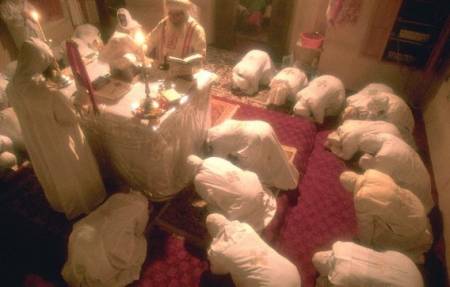
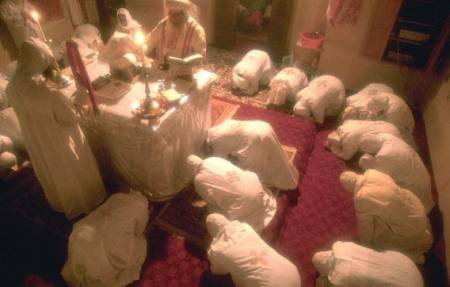
Prostration inside the altar

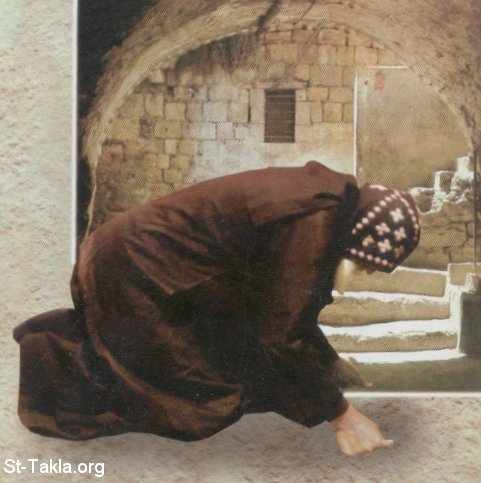
Prostration and chanting Kyrielyson is one of the most unique and blissful tradition of Orthodox Churches. Especially during Great lent and passion week numerous prostrations are preformed. In Coptic Church following the 11th and the 12th hour during Good friday service , the whole congregation prostrate(Kumbidil)(Metanis) and chants  Kyrielyson 400+ time (100 facing each direction).

During 11th and the 12th hour after the readings, the cross is raised by the Patriarch or Bishop or Senior priest. Starting from east direction and the whole congregation chants Kyrielyson (Lord have mercy) with prostration (full or half) first facing east direction.  100 times facing east , 100 times facing west, 100 times facing north, 100 times facing south. Following this the clergies and congregation faces east again and continue further 12 kyrielyson chnated in a log tune.

It was a blessed experience when the whole congregation in St Marks Cathedral alexandria (may 3000 believers) chanting kyrielyson.

Orthodox way of prostration

Similarity with Indian Church.
This tradition is same in all the oriental churches. In Indian Orthodox church there is service of sleeba vandanam during which everyone prostrate and kiss the Holy Cross one by one. Again during burial service congregation prostrate and chant Kyrielyson. Coptic church performs the burial service after the recitation of Kyrielyson 400 times.

Feet washing Service at Coptic Church

Khristos Anesti! +++

Feet Washing service in Coptic Church and Indian Church:

This Service is observed in remembrance of what happened on Holy Thursday when Jesus washed the feet of his twelve disciples prior to the Last Supper. And laid an example to all Christians showing the extent of humility in Christian life.

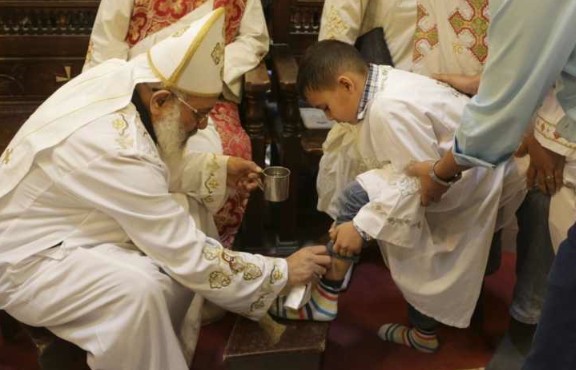
This year I attended the service at Coptic Church. Service was same like Indian and other Oriental churches except , In Coptic church Priest washes the feet of entire Male congregation and water is sprinkled over the female congregation. Service is performed by the parish priest mostly, not just by a bishop . Due to large crowd, normal priest makes sign of cross only rather washing it. The Church I went had a strength of about 2000 people. I was also blessed with this service.
wp_ss_20150416_0001
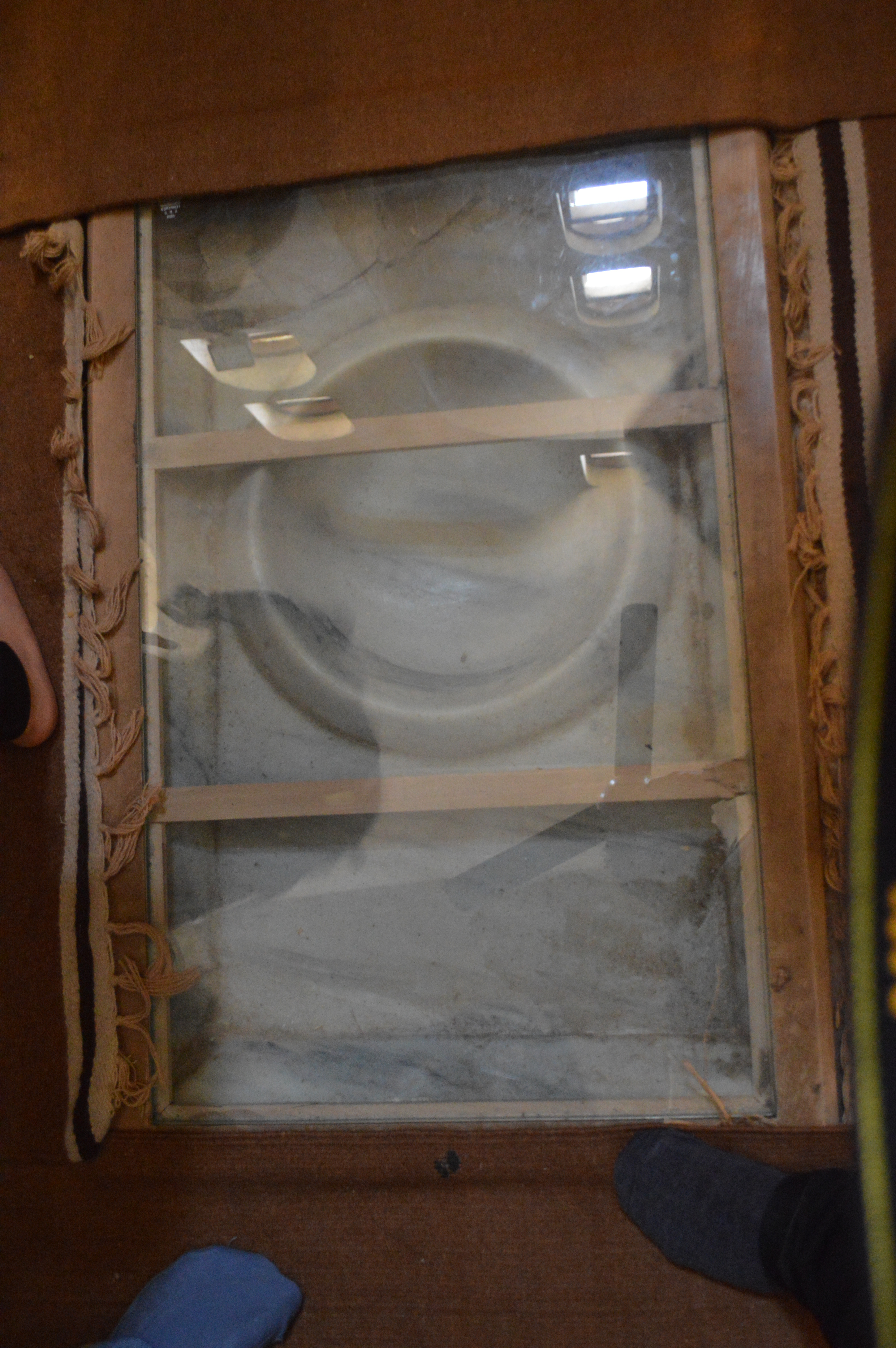
In olden days, there use to be a vessel attached to the ground which was specially for foot washing ceremony. It can be seen in some old monasteries like Syrian monastery.

DSC_0178
I feet washing hole, in Syrian monastery

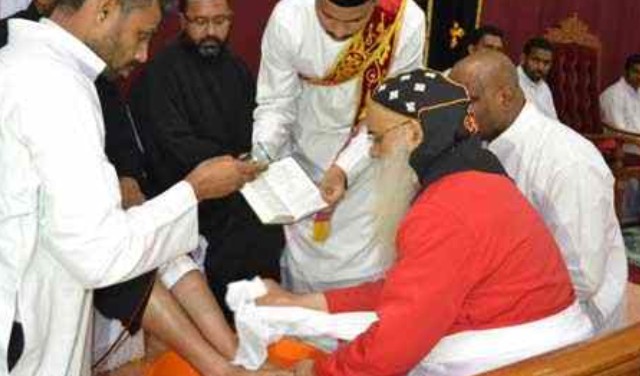
In Indian Church and Syrian Church this service is performed only by a Bishop. There will be some 12 selected persons, both priests and the lay people, and the Bishop will wash and kiss the feet of those 12 persons . (As seen in picture)

H.H the Catholicos of East

Anointment of entire congregation on the day of Holy unction(last friday before Pasca))

Khristos Anesti ! +++

A brief description of my experience during Friday of Holy unction, when entire congregation was anointed.

IMG-20150403-WA0001

Holy Unction for the entire Congregation

Sacrament of Holy unction is one of the Seven sacraments of Orthodox Church, through which the sick who are faithful, are healed from psychological and physical diseases.  The priest anoints the person with the holy oil from which they obtain the grace of remedy from God. As mentioned in James 5:13

“Is anyone among you sick ? Let him call for the elders of the church , and let them pray over him , anointing him with oil in the name of the Lord .”

But till now I thought that the sacrament of Holy Unction was done only for sick people. But this year (2015) I experienced an early Christian tradition practiced on Friday before the Passion week (Pasca), in which the entire congregation is anointed with Holy oil. The Friday of Holy unction.

I came to know through Ramy Fausy, one of my Coptic friend, that there is a English service once in a month in St George Coptic Orthodox Church, Heliopolis. I have been to this church for Christmas service. Within this church compound there is a small chapel dedicated to St Pishoy of Egypt. There Abouna Boulos , a young Coptic Priest celebrates Holy Eucharist in English once in a month.

Morning Prayer (Namaskaram) of Holy unction

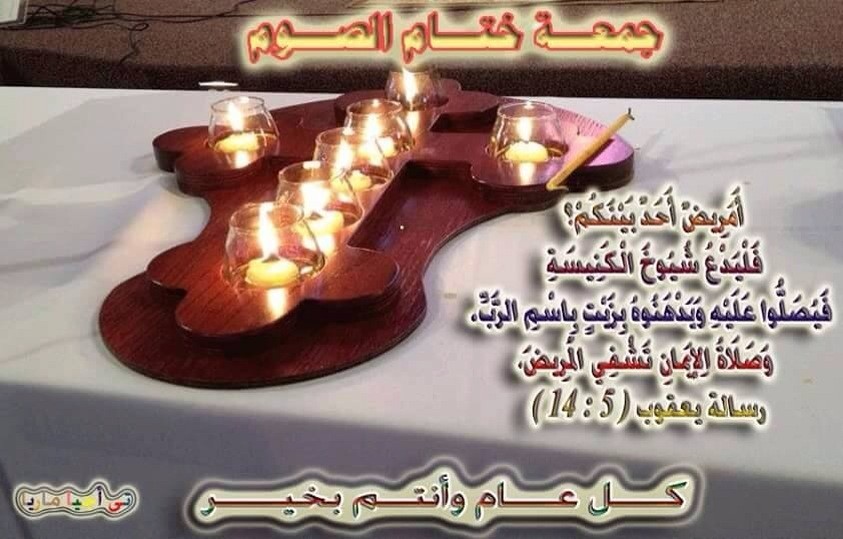
Early morning at 6:30 I reached the Church. Wearing my white color deacon robe I entered the Holy Altar. The deacon robe of Indian church is fully white unlike the deacon robe of Copts, which have shape of cross on it. I was surprised to see that the prayers were different and there was something kept on the table. Something with oil on it and Seven wicks making a shape of Cross.

Later did I came to know that its Friday before Passion week , the day of Holy unction. It is called the day of Sacrament of Lamps for the early Christians used to place oil in a lamp on this day from which hung seven other lamps. Each lamp was lit at the beginning of every prayer. The morning prayer is divided into seven parts. This rite still exists, however, the seven lamps were replaced by seven wicks, made from cotton wool, which sit in a plate of oil. This prayer is known as Kandeel, same like kandeela Service , termed by Indian/ Syriac Church. After every prayer, priest lit the wick which finally makes a shape of cross(as shown in picture)
This service is same for wnnointment of sick but with some little changes in words like on this day prayers are performed in the plural forms, hence, instead of the priest saying: Lord heal Your servant (…name), he says: Lord heal Your attending servants.

Anointment of Entire Congregation

After the seven prayers and lightening of seven lamp is accomplished , priest anoints the entire congregation , starting with his fellow priest and deacons. I was also blessed to be anointed. The Priest anoints the forehead, down neck and both the hands. Then prayers begin for celebrating the last holy Eucharist in Lent.

Reason why the whole congregation is anointed

Anointing all the believers prior to Passion Week, for it is not permissible to perform the Sacrament of Unction of the Sick during the Holy Week, even funeral rites are not allowed to take place during Passion Week. In the Byzantine and Coptic liturgies, the entire congregation is anointed with oil, usually on the evening of Holy Wednesday in the Byzantine and on the Friday before Lazarus Saturday in the Coptic.  In the Coptic Rite this is connected to the idea that these services of Unction and funeral being unavailable in Holy Week.
*Even there is a General Funeral for anyone who dies in Holy Week after the Palm Sunday service (will write about it later).

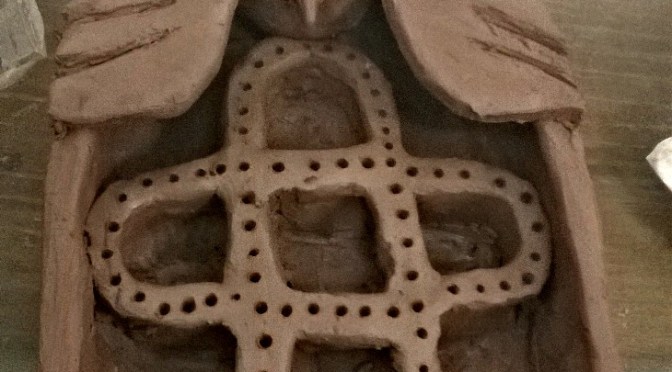
Ancient Coptic pottery with seven lamps

When I made this pottery I didn’t knew the importance of it . Now I know its meaning and importance. Although the pottery tradition is almost forgotten now seven wicks are used in place of clay lamps. This pottery is entirely made in Brown nile clay. In Byzantine Churches Seven candles are used (as shown in Figure).

PicsArt_24-11-2014 23_20_34

Holy unction in Indian Orthodox Church

I am not much aware of how it is done in Indian Church. But I am sure that this sacrament is done only for sick people. The number of lamps is Five and not Seven. Five number signifies the 5 wound of Christ which is also made in Qurbana bread.