
Fr. Rijo Geevarghese
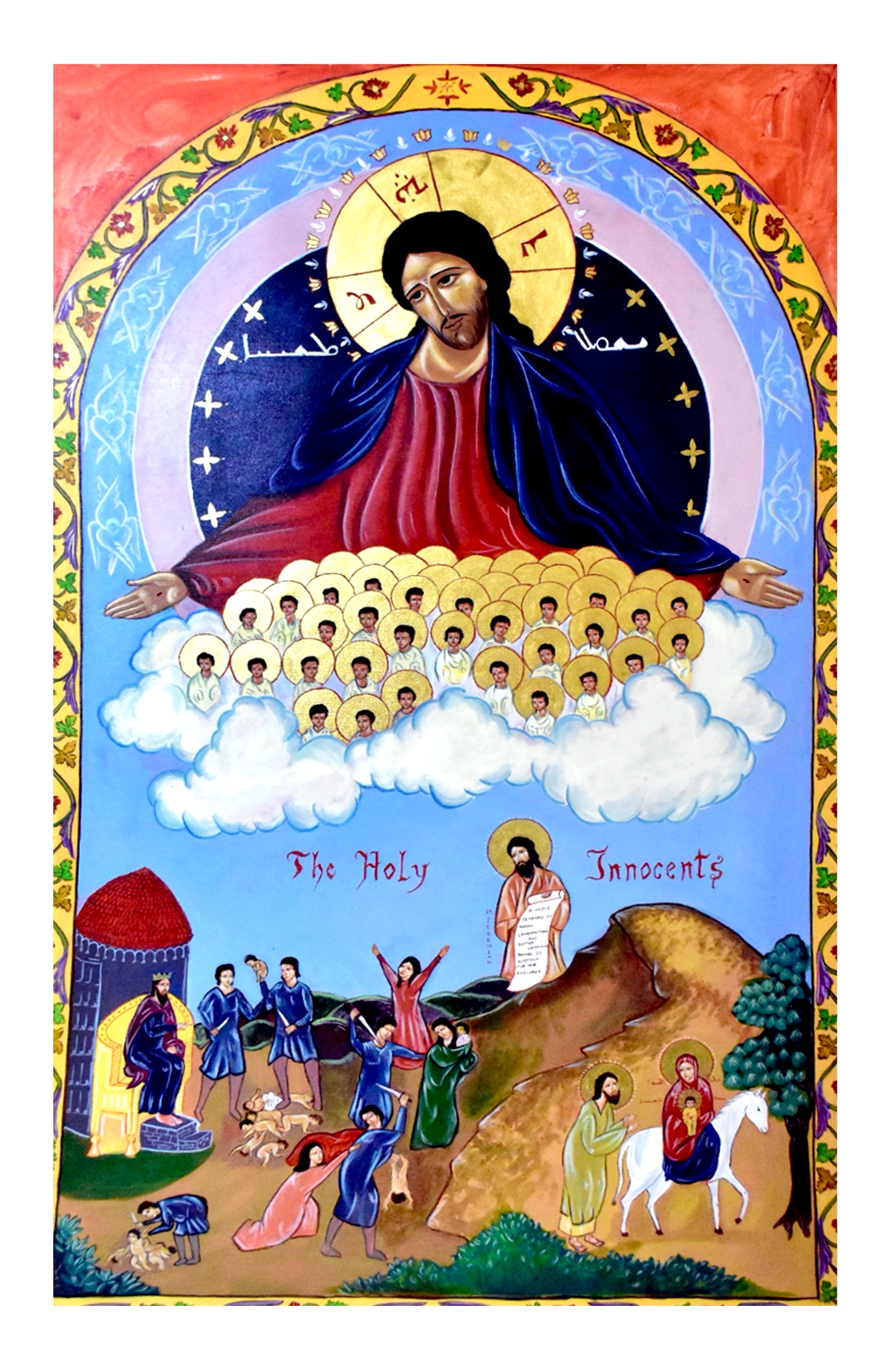
The Orthodox Icon of the Holy Innocents portrays the tragic event described in the Gospel according to Matthew (Matthew 2:16-18) when King Herod, upon learning from the Magi about the birth of a new king in Bethlehem, ordered the massacre of all male children under the age of two in Bethlehem and its vicinity. Here’s a detailed breakdown of the icon’s meaning:
1. Central Depiction: In the centre of the icon, one can see a group of infants or young children, often depicted with angelic faces and halos along with Christ. Christ is shown as embracing them. One can also notice the wounds in Christ’s hands showing His sharing with sufferings of the Children. It also symbolizes the sufferings of innocent victims throughout history across the world. Thus, this icon surpasses the spatial and temporal dimensions and exhibits the present reality as well.
2. Mother Mary and Infant Jesus: Mother Mary and the Infant Jesus are depicted in the icon as well along with St Joseph. Their presence emphasizes the context of the massacre, and their flight to Egypt.
3. Prophet Jeremiah: Jeremiah, an Old Testament prophet, is often depicted in the icon because of his prophecy regarding the massacre of the children by King Herod. In the Book of Jeremiah (Jeremiah 31:15), he foretold the weeping and lamentation of Rachel, for her children who were no more. Jeremiah’s presence emphasizes the prophetic aspect of the tragedy. He serves as a witness to the fulfilment of his own prophecy, underscoring the divine foreknowledge of the events and the significance of the Holy Innocents’ suffering in the grand narrative of salvation history.
4. First Martyrdom: In Christian tradition, the Holy Innocents are considered martyrs, even though they did not have the opportunity to consciously profess their faith. Their innocent deaths are seen as a witness to the truth of Christ and the cost of discipleship.
6. Hope and Redemption: Despite the darkness of the event, the presence of the Holy Family in the icon offers hope and redemption. In Christian theology, Jesus’s birth, life, death, and resurrection ultimately bring salvation and victory over sin and death.
7. Prayer and Reflection: For Orthodox Christians, icons are not merely decorative but are considered windows into the spiritual realm. It serves as a focal point for prayer, meditation, and reflection. The Icon of the Holy Innocents invites viewers to contemplate the meaning of suffering, innocence, and the divine presence amidst tragedy.
8. Writings in the Icon:
- Meaning of three-letters used behind the Halo of Christ in the Icon:
The first letter ܐ and last letter ܬ in Estrangela (on either sides of the halo) means, He is the beginning and end, the Alpha and Omega. The third Estrangela letter (at the top) is the combination of the two letters: ܝ (yodh) and ܗ (heh). These two letters are equivalent to the Hebrew Tetragrammaton יהוה (YHVH), with three points above signifying the three persons of the Trinity, and one point below signifying oneness forming ܞ. This was an ancient symbol used in the Old Syriac text as well as in sacred artforms like icons denoting the Divine name. This Symbol ܞ is scribal abbreviation of the Name of God as revealed to Moses on Mt Sinai (Exodus 3:14).
- Syriac script on either side of Christ is Yeshu Mashiho written in West Syriac script. Likewise on either side of Mother Mary is Yoldath Aloho, meaning Mother of God.
- Scroll held by Prophet Jeremiah: It resembles the prophecy from the book of Jeremiah 31:15,
“A voice is heard in Ramah, lamentation and bitter weeping. Rachel is weeping for her children.”
The Orthodox Icon of the Holy Innocents communicates a profound message about the nature of innocence, suffering, martyrdom, and the redemptive power of Christ’s love. Contemplating this icon can evoke reflection on the innocence and vulnerability of children, the tragic consequences of human greed and power, and the ultimate triumph of good over evil. It can also inspire empathy and compassion for the innocent victims of violence throughout history and in contemporary times. It invites Christians to remember and honour the memory of the Holy Innocents while also inviting us to care for the vulnerable in society.
This icon is written on canvas (dimension: 6.8 x 4.2ft) by the unworthy hands of Fr. Rijo Geevarghese.
 Graphē